
Last updated September 10, 2026
Full 25-point door and opener safety check with every visit - springs, cables, rollers, tracks, and your LiftMaster or Chamberlain opener included
You get a price before we start. It does not change when the truck arrives.
 Before
 After
After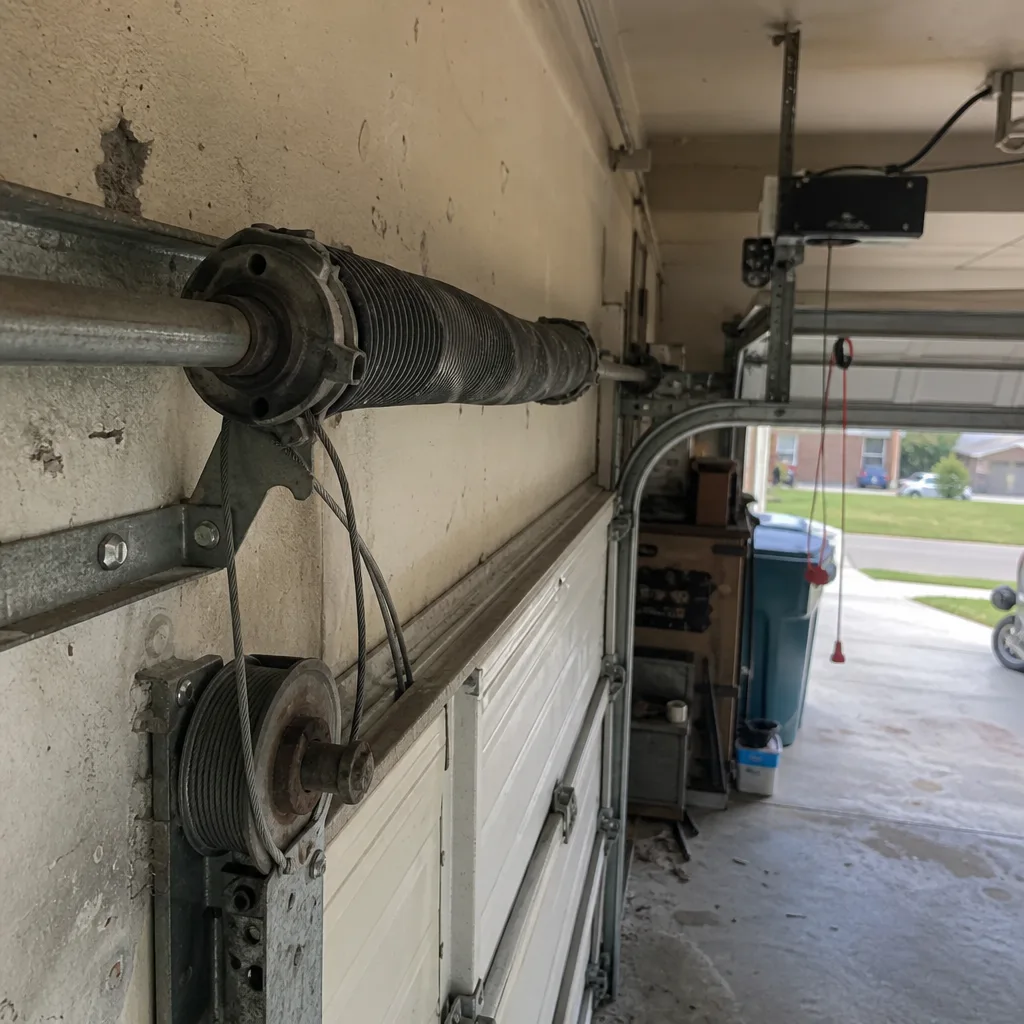 Before
 After
After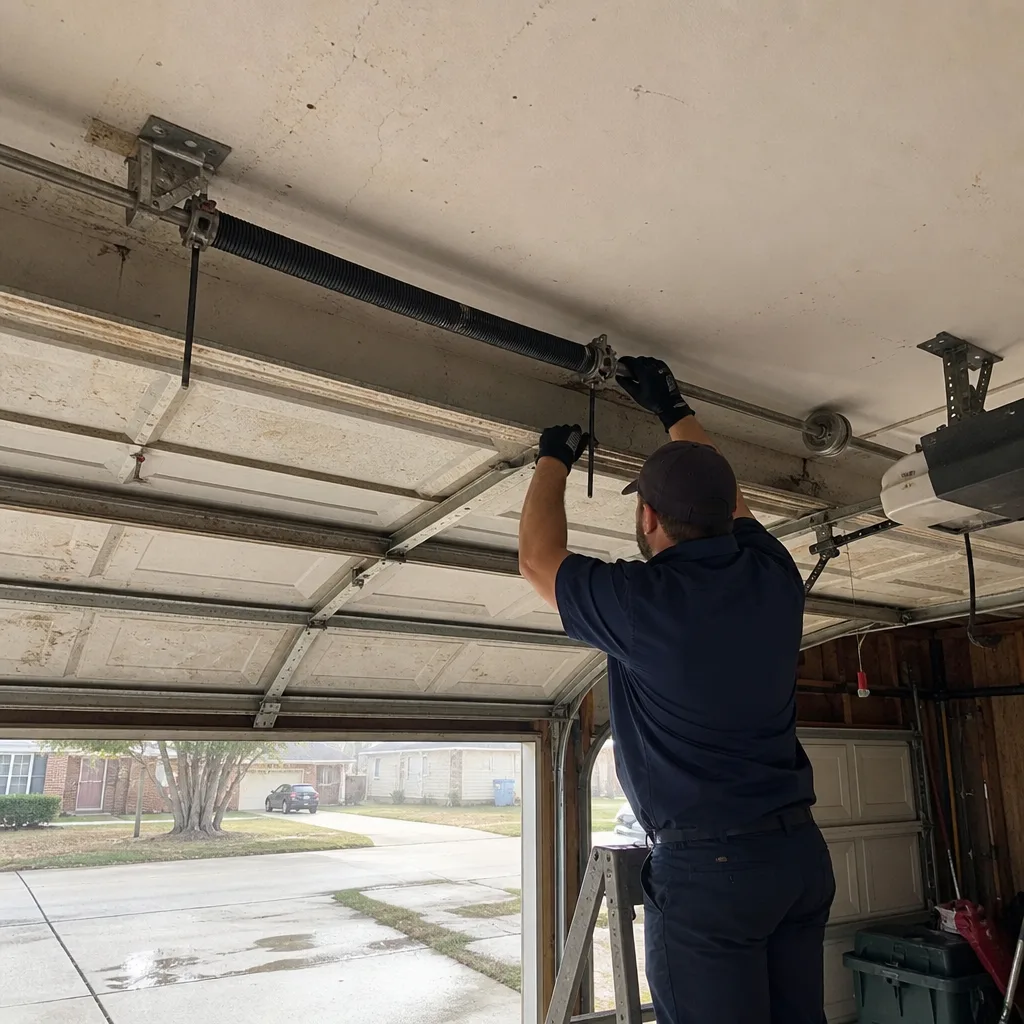 Before
 After
AfterGarage Door Repair Maintenance Checklist for Rosenberg Homeowners
In Rosenberg, the component that fails first is almost never the one a generic checklist tells you to watch. Torsion spring fatigue accelerates faster here because of temperature swings between air-conditioned garages and 98°F afternoons. We’ve spent four decades watching doors in Fort Bend County, and the failure sequence is predictable: springs weaken under thermal stress, cables fray from misaligned drums, and openers strain until they quit mid-cycle. This guide orders every task by actual failure frequency in our climate, not alphabetical convenience. You’ll learn what to inspect, when to inspect it, and which Garage Door Warning Signs: A Rosenberg Homeowner’s Reference Guide mean a call is overdue.
Quick Answer
A proper garage door maintenance checklist for Rosenberg homeowners includes monthly visual inspections of springs and cables, quarterly lubrication of rollers and hinges with heat-stable silicone, bi-annual weather seal checks for UV damage, and post-storm alignment verification after severe weather. Most critical: the two-minute cable-drum check that catches spring fatigue before it snaps. Perform the full routine twice yearly, in March before storm season and October after peak heat subsides.
Table of Contents
- Why Rosenberg’s Climate Destroys Garage Doors Differently
- The Monthly Two-Minute Cable-Drum Check
- Spring Inspection: What Heat Fatigue Looks Like
- Lubrication in Humid Heat: What Works and What Gums Up
- Weather Seals and Threshold Gaps: The Rosenberg UV Pattern
- Opener Safety Systems and Force Settings
- Month-by-Month Maintenance Calendar
- Tools and Supplies for Home Inspection
Why Rosenberg’s Climate Destroys Garage Doors Differently
Generic maintenance checklists assume moderate humidity and seasonal freezes. Rosenberg offers neither. Our Gulf Coast location means 80% humidity in July, clay soil that swells and shrinks with every rain, and UV exposure that degrades rubber seals on south-facing doors in eighteen months instead of five years.
The thermal cycle is the hidden killer. A garage in the Meadows at Imperial Oaks might hit 62°F at 7 AM with the AC running, then 98°F by 4 PM with the door open. That 36-degree swing happens 180 days a year. Torsion springs are engineered for roughly 10,000 cycles under stable conditions. In Rosenberg, the thermal expansion and contraction of the steel cuts effective cycle life by 20 to 30 percent. We’ve replaced springs in the Lakes of Rosenberg subdivision after seven years that should have lasted twelve.
Clay soil movement creates a second problem unique to our area. When the ground swells after a heavy rain, then contracts in August drought, concrete garage thresholds shift. A gap opens beneath the door. The bottom seal, already UV-brittle, gets pinched and torn. Mice, water, and conditioned air escape through the opening. In the Pecan Grove area, where lots sit lower and drainage is slower, we’ve measured threshold gaps exceeding three-quarters of an inch after wet winters.
Storm season adds a third variable. A garage door is the largest moving wall in your house. When a June thunderstorm hits with 60 mph winds, a misaligned door or weak spring lets the panel rack and twist. The opener strains. Cables slip off drums. What started as a minor alignment issue becomes a Saturday emergency.
This checklist addresses these specific failure modes in order of frequency. Spring fatigue comes first because it causes the most damage. Lubrication follows because humidity changes what works. Seals and thresholds come next because they’re the most visible early warning. Opener settings finish the routine because they reveal problems already developing in the mechanical system.
The Monthly Two-Minute Cable-Drum Check
This single check catches more imminent failures than any other routine. Do it with the door closed, the opener disconnected, and the interior light on.
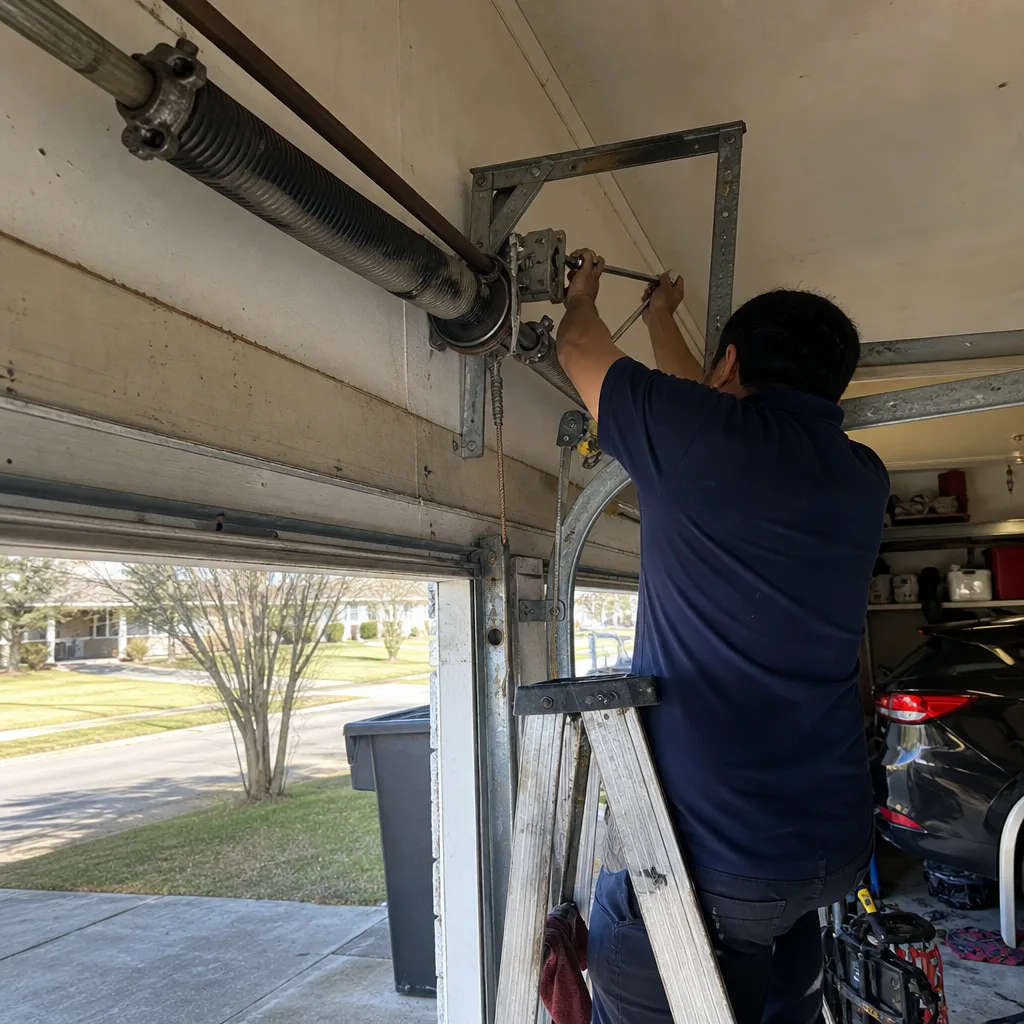
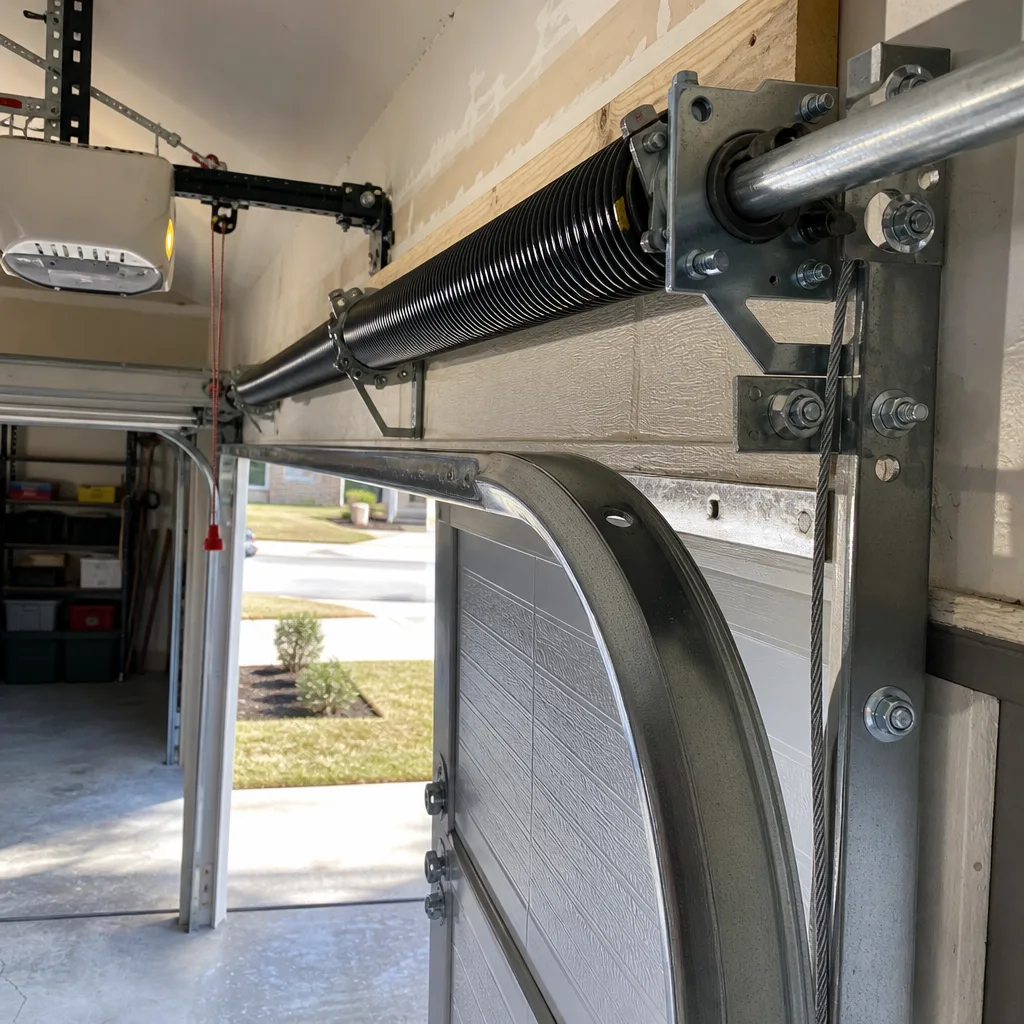
- Look at the cable where it wraps the drum. The drum is the grooved wheel at each end of the spring shaft. The cable should sit neatly in the grooves, with no overlap, no gap, and no frayed strands poking outward. A cable that has slipped even one groove is under uneven tension. That uneven tension transfers to the spring, accelerating fatigue.
- Check for rust dust. Run a finger along the bottom of the drum assembly. Fine reddish-brown dust means the cable is fraying internally. The strands are wearing against each other. In Rosenberg’s humidity, this process speeds up once it starts. We’ve found rust dust on three-year-old cables in the Brazos Landing area where garage ventilation was poor.
- Watch the cable path. Trace the cable from drum to bottom bracket. It should run straight, not rubbing against the track edge or the door panel. A cable that chafes loses strength predictably. A snapped cable under tension is dangerous. The door drops hard, and anything under it is crushed.
What you’re really checking: cable position reveals spring balance. When a spring weakens on one side, the door rises unevenly. The cable on the weaker side goes slack, slips a groove, then re-tightens with a jerk. That jerk frays the cable. By the time the cable looks bad, the spring has been failing for months.
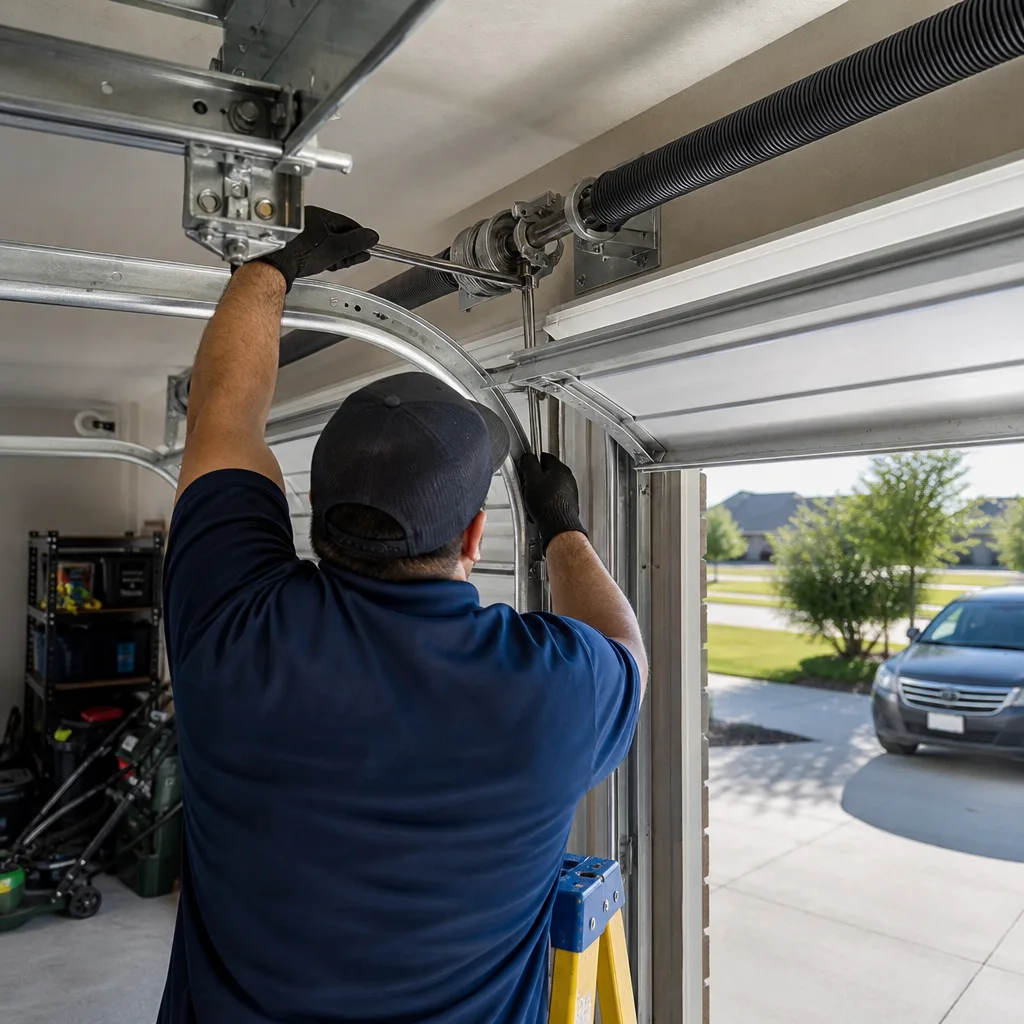
If you find rust dust, a slipped cable, or visible fraying, stop using the door. Disconnect the opener if it’s connected. This is not a homeowner repair. Torsion springs store enough energy to cause serious injury or death. Garage door repair in Rosenberg by a trained technician includes spring replacement with the door safely restrained and new cables installed as a matched set.
Carl Dutton has handled spring failures in Rosenberg since 2016. The calls that come in after a cable snaps are always more expensive than the ones that come in after a homeowner noticed rust dust. The two-minute check is worth every second.
Spring Inspection: What Heat Fatigue Looks Like
Torsion springs sit above the door, wound tight, carrying the full weight of the panels. In Rosenberg, they work harder than the manufacturer intended.
Visual signs of heat fatigue:
- Gapping between coils. A healthy spring has coils that sit close together when the door is down. As the steel fatigues, the spring lengthens slightly. You can slide a business card between coils that used to touch. In severe cases, we’ve measured quarter-inch gaps on springs in the Rosenberg Ranch area that were only six years old.
- Surface rust with pitting. Light surface rust is normal. Pitting, tiny craters in the steel surface, is not. Pitting creates stress concentrators. The spring breaks at the pit, usually with the door in motion. A spring that breaks with the door open leaves it hanging, sometimes at an angle that jams the tracks.
- Oil streaks on the spring or wall. Some springs are oil-tempered. When the internal structure degrades, oil weeps out. It’s a sign the spring has exceeded its design life. We’ve seen this on oil-tempered springs in the Summerfield subdivision after just five Texas summers.
- A loud bang, once. If you heard a bang from the garage six months ago and never figured out what it was, check your springs now. That was probably a spring breaking. Doors with two springs can run on one for a surprisingly long time, but the remaining spring is overloaded and dangerous.
The balance test: Disconnect the opener. Lift the door manually to waist height. Release it slowly. A balanced door stays put or drifts no more than a few inches. A door that falls hard has weak springs. A door that rises has springs that are too strong, which is rare but hard on the opener.
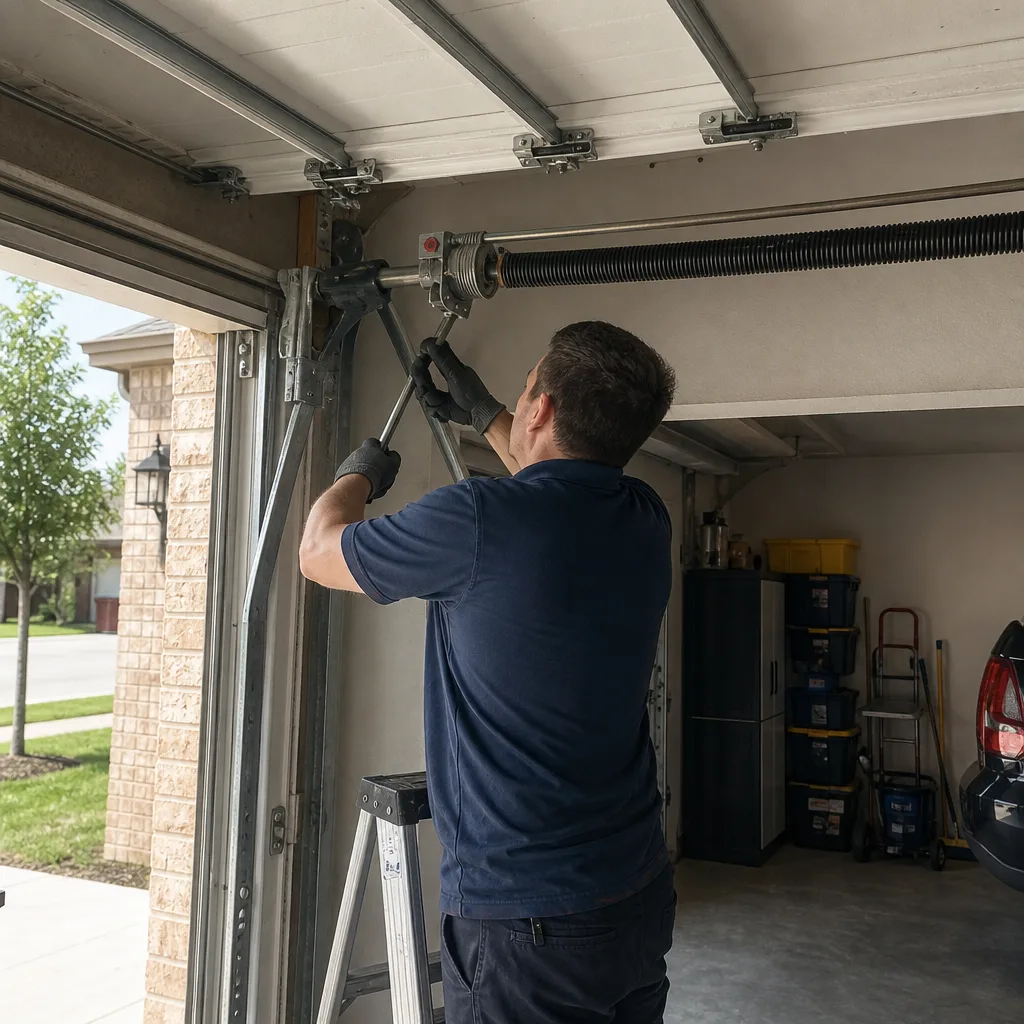
Never attempt to adjust or replace torsion springs yourself. The winding cone stores lethal force. Even with proper bars and knowledge, a slip can break bones or worse. Our technicians at Mainspring Garage Door Co. home carry spring sets for all common door weights and configurations, so most spring replacements are completed in a single visit. The 90-Day Done Right Promise covers the work in writing. If it’s not right, we come back. No paperwork, no arguing.
Lubrication in Humid Heat: What Works and What Gums Up
This is where generic checklists fail Rosenberg homeowners badly. The lithium grease that works fine in Denver turns to black glue here. WD-40, never a lubricant for this purpose, evaporates and leaves a sticky residue that collects Gulf Coast dust.
What to use:
- Silicone spray with Teflon (PTFE). Look for products rated for -35°F to 200°F. The Teflon bonds to the metal surface and stays through humidity cycles. We use and recommend this for hinges, rollers, and bearing plates. Apply sparingly. A thin film is protective. A thick film attracts grit.
- White lithium grease, sparingly, on screw-drive opener rails only. If you have a Genie or similar screw-drive opener, the manufacturer specifies lithium. Apply a thin line, run the door twice, then wipe excess. In Rosenberg humidity, reapply every four months instead of annually.
- Garage door specific lubricant. Several manufacturers formulate for high-humidity climates. These are worth the extra cost if you want one product for everything. Read the temperature range on the can. Anything with a top limit below 180°F is wrong for a Texas garage in August.
What never to use:
- Standard WD-40. It’s a water displacer and penetrant, not a lubricant. The residue gums up in heat.
- Motor oil or 3-in-1 oil. These oxidize and varnish in humid heat. Rollers will stick instead of roll.
- Graphite powder. It works in dry climates. Here it clumps with moisture and makes a mess.
Where to lubricate:
- Hinges at every panel joint. One quick spray per hinge, both sides.
- Roller bearings, not the wheel surface. The wheel needs to grip the track. Lubricate the bearing inside the wheel.
- Bearing plates at each end of the spring shaft. These take the rotational load.
- Lock mechanism, if present. A stuck lock in humid weather is frustrating.
Where never to lubricate: The track itself. Lubricated tracks collect dust and become gritty. The rollers should roll, not slide. The track should stay clean and dry. Wipe it with a dry cloth if dusty.
In Rosenberg, lubricate in March before storm season and again in late September after peak heat. The March application protects through summer. The September application addresses the wear from three months of heavy use. If your garage faces south and gets no shade, consider a mid-June touch-up on hinges and rollers.
Weather Seals and Threshold Gaps: The Rosenberg UV Pattern
South-facing garage doors in Rosenberg show a specific UV damage pattern we’ve documented across hundreds of service calls. The bottom seal dries and cracks first on the side that gets morning sun, then progresses across. By month eighteen, the seal is leaking air, water, and light. By month thirty, it’s torn and mouse-accessible.
The UV inspection:
- Close the door in daylight. Look for light leaks under the seal. Any visible line means the seal is compressed or cracked.
- Run your hand along the seal’s bottom edge. It should feel flexible and slightly tacky. If it’s hard, glazed, or crumbling, it’s done.
- Check the sides and top. Rubber bulb seals on Clopay and Amarr doors degrade similarly. Vinyl flap seals last longer but stiffen and crack at the fold.
Threshold gaps from clay soil movement:
Place a straightedge, even a yardstick, across the garage floor at the door opening. Look for gaps between straightedge and concrete. A gap over one-quarter inch means the threshold has shifted. The bottom seal cannot compensate. Water runs in during heavy rain. In the Meyer Park area, where drainage is slow, we’ve seen water pool against the door and seep through gaps that homeowners didn’t know existed, which is why How to Hire a Garage Door Contractor in Rosenberg: A Step-by-Step Guide matters when threshold issues arise.
Measure the gap at its widest point. Under three-eighths inch: a taller bottom seal or threshold insert may work. Over three-eighths inch: the concrete needs leveling or the door needs re-hanging to match the new floor plane. This is not a DIY project. The door must be removed from the tracks, the spring tension addressed, and the hardware re-aligned.
For south-facing doors, consider a UV-resistant EPDM seal instead of standard vinyl. It costs more upfront and lasts roughly twice as long in Rosenberg exposure. We stock EPDM seals for Wayne Dalton and standard Clopay profiles, and can order for other manufacturers.
Opener Safety Systems and Force Settings
The opener is the brain, but it depends on the door being mechanically sound. A misaligned or unbalanced door forces the opener to work harder, shortening its life and creating safety risks.
Monthly safety reversal test:
- Place a 2×4 flat on the floor, centered under the door path.
- Close the door using the wall button, not the remote.
- The door should reverse within two seconds of contacting the board.
- If it doesn’t reverse, or if it reverses before touching the board, the down-force limit needs adjustment.
Photo-eye test:
- Start the door closing.
- Sweep a broom handle through the beam between the two sensors.
- The door must reverse immediately. If it continues, the sensors are misaligned, dirty, or failed.
Force setting relevance to Rosenberg:
Heat affects opener electronics. Circuit boards in non-ventilated housings run hot. Force settings drift as components age in thermal stress. A door that reversed properly in March may not in August. We check force settings on every service call, and we find them out of spec on roughly one in three openers over five years old.
If your opener is a Genie chain-drive or belt-drive model, the force dials are under the light cover. Chamberlain and LiftMaster units hide them behind the hanging cover or in the side panel. Refer to your manual for location. Turn adjustments in quarter-turn increments, testing after each change. If you’re unsure, call. A door that doesn’t reverse can injure a child or pet. The garage door opener in Rosenberg service from Mainspring includes force verification, safety system testing, and travel limit confirmation.
Never increase force settings to compensate for a sticking door. The door is sticking for a reason. Find and fix the mechanical problem. Increased force settings mask the problem until the opener fails or someone gets hurt.
Month-by-Month Maintenance Calendar
This calendar aligns tasks with Rosenberg’s actual weather pattern, not a national average.
March: Pre-Storm Season Preparation
- Full cable-drum, spring, and hinge inspection
- Lubricate all moving parts with silicone/Teflon spray
- Test opener safety reversal and photo eyes
- Inspect weather seals for winter UV damage
- Check threshold for gaps opened by winter soil moisture
April-May: Storm Watch
- After every severe weather event: check door alignment, track bolts, and opener mounting bracket
- Listen for new noises during operation. Grinding, popping, or squealing that starts after a storm often means a track shift or spring stress.
- Clear drains and gutters that feed toward the garage. Water against the door accelerates seal and threshold problems.
June-August: Peak Heat Management
- Mid-June: quick hinge and roller touch-up if south-facing
- Monthly cable-drum checks continue
- Monitor opener for thermal shutdowns. If the opener stops mid-cycle on the hottest afternoons, the motor is overheating. Improve ventilation or schedule motor assessment.
- Check bottom seal for heat-hardening. A seal that was flexible in March may be glazed by July.
September: Post-Heat Recovery
- Full lubrication cycle
- Spring balance test. Heat fatigue shows most clearly after peak stress.
- Inspect all seals. Replace if hardened or cracked before winter.
October-November: Pre-Cool Season
- Final seal check before heating season. A leaky seal costs more in conditioned air loss than most homeowners realize.
- Verify weatherstripping on door to house. The garage door seal and the house door seal work together.
- Schedule professional tune-up if not done since spring. Our $89 Seasonal Tune-Up includes everything in this checklist, performed by a journeyman technician.
December-February: Freeze Watch
- Rosenberg freezes are rare but hard. After any freeze, check for cracked seals that went brittle overnight.
- Watch for opener strain on cold mornings. Lubricant thickens in cold. If the door seems sluggish, the lubricant may need renewal or the springs may be near failure.
- Threshold gaps often shrink in winter dry spells as clay contracts further. Note the maximum gap for spring repair planning.
Tools and Supplies for Home Inspection
You don’t need much. Quality matters more than quantity.
- Flashlight with focused beam. For examining spring coils and cable condition in the shadow above the door.
- Silicone/Teflon spray, two cans. One for application, one spare so you don’t skip a cycle because the can ran empty.
- Clean rags. For wiping tracks, cleaning photo-eye lenses, and removing old lubricant buildup.
- 2×4 scrap, 18 inches. Dedicated to the safety reversal test. Store it in the garage, marked, so it’s always available.
- Yardstick or straightedge. For threshold gap measurement.
- Work gloves. Cables have sharp edges. Springs have rough surfaces. Protect your hands.
- Binoculars (optional). For examining spring coils without climbing. Never climb to inspect springs. The risk is not worth the view.
Store supplies in a cabinet, not on the garage floor. Humidity degrades spray cans over time. A cool, dry storage extends shelf life.
Common Mistakes to Avoid
- Using the wrong lubricant and calling it maintenance. A homeowner in the Plantation Lakes area used standard lithium on everything for three years. By the time we saw it, the tracks were coated in black tar, rollers were sliding not rolling, and the opener was failing from overload. The wrong lubricant is worse than none.
- Ignoring a single loud noise. A bang from the garage is never nothing. It’s a spring breaking, a cable snapping, or a door panel cracking. Investigate immediately, or call for investigation.
- Testing the safety reversal with your foot. The 2×4 test is specified by UL 325 for a reason. Your foot is not a standardized test object, and a door with failed reversal can break bones.
- Adjusting torsion springs with YouTube confidence. We’ve been called after three DIY spring injuries in Rosenberg since 2016. Two required emergency room visits. The videos never show the accidents.
- Waiting for complete failure. A spring with visible coil gaping will fail. It’s not a question of if. Emergency calls cost more than scheduled service, and a failed spring often damages cables, drums, and panels.
- Neglecting the threshold after foundation repair. Foundation work changes floor plane. The door that sealed before may not seal after. Re-check alignment and gap within thirty days of any foundation work.
When to Call a Professional
Call when you find rust dust on cables, gapping in spring coils, a door that fails the balance test, or any opener safety system that doesn’t respond correctly. Call after any storm that shifts the door in its tracks or damages panels. Call if the threshold gap exceeds three-eighths inch or if water enters the garage during rain.
Carl Dutton and the team at Mainspring Garage Door Co. offer our Garage Door Repair services with free estimates in Rosenberg. A technician arrives with a fully stocked truck, assesses the door, and states the flat price before any work begins. Most repairs are completed in a single visit. The 90-Day Done Right Promise covers every job in writing. Call (281) 315-3920 to schedule.
Frequently Asked Questions
Perform the full inspection and lubrication cycle twice yearly, in March and September, with monthly two-minute cable-drum checks between. The March timing prepares for storm season and peak heat. The September timing addresses wear from summer stress and prepares for cooler months. Monthly cable checks catch the most common failure mode before it becomes dangerous.
A professional seasonal tune-up from Mainspring Garage Door Co. is $89 and includes full inspection, lubrication, safety system testing, and written condition report. Repair costs vary by component: spring replacement typically runs $180-$340 depending on door size and spring type, cable replacement $120-$200, and opener repairs $150-$400. We state the flat price before any work begins, so there are no surprises on the bill. Call (281) 315-3920 for a free estimate.
Homeowners can safely lubricate hinges, rollers, and bearing plates with proper silicone/Teflon spray. Avoid the track surface, and never lubricate springs or cables. If you’re uncertain which product to use or where to apply it, the $89 Seasonal Tune-Up includes professional lubrication with the correct materials for Rosenberg’s climate. The technician will also spot developing problems you might miss.
Heat expands metal components and thins lubricant. Hinges and rollers that were quiet in March may squeak in July as clearances change and lubricant migrates. Humidity can also cause minor rust formation on unprotected surfaces. A mid-summer touch-up lubrication often solves summer noise. If noise persists after lubrication, it may indicate spring fatigue or bearing wear that needs professional assessment.
Standard torsion springs are rated for 10,000 cycles. In Rosenberg’s thermal stress environment, expect 7,000 to 8,500 effective cycles, typically 7 to 9 years for a door used four times daily. High-cycle springs rated for 25,000 or 50,000 cycles last proportionally longer and are worth considering if you plan to stay in your home. We stock and install high-cycle springs for all major door brands including Clopay, Amarr, and Wayne Dalton.
No. Mainspring Garage Door Co. states the flat price before any work begins. The estimate you approve is the price on the invoice. If we discover additional problems during service, we explain them and quote separately before proceeding. You choose. This is our no-surprises policy, and it’s been in writing since 1984. Call (281) 315-3920 for your free estimate.
The Bottom Line
Rosenberg’s climate demands a maintenance approach that generic checklists don’t provide. The two-minute cable-drum check, done monthly, catches spring fatigue before it cascades into cable failure and panel damage. Silicone/Teflon lubrication, applied in March and September, survives our humidity and heat where other products fail. UV-resistant seals and threshold gap monitoring address the specific wear patterns we’ve documented across four decades in Fort Bend County. The calendar is simple: inspect monthly, maintain fully twice yearly, and call at the first warning sign rather than after failure. For more guides & resources, explore our blog. A garage door that receives this attention will operate quietly, safely, and predictably for years. One that doesn’t will eventually fail at the worst possible moment, usually during a storm or when you’re already late.
Garage door installation in Rosenberg by Mainspring includes proper setup for our climate from day one, with components selected for thermal stress resistance and UV exposure. Whether your door is new or twenty years old, the maintenance principles remain the same: watch the cables, respect the springs, lubricate with the right product, and never ignore a change in sound or motion.
Written by Carl Dutton, Owner at Mainspring Garage Door Co., serving Rosenberg since 2016.