
Last updated September 10, 2026
Full 25-point door and opener safety check with every visit - springs, cables, rollers, tracks, and your LiftMaster or Chamberlain opener included
You get a price before we start. It does not change when the truck arrives.
 Before
 After
After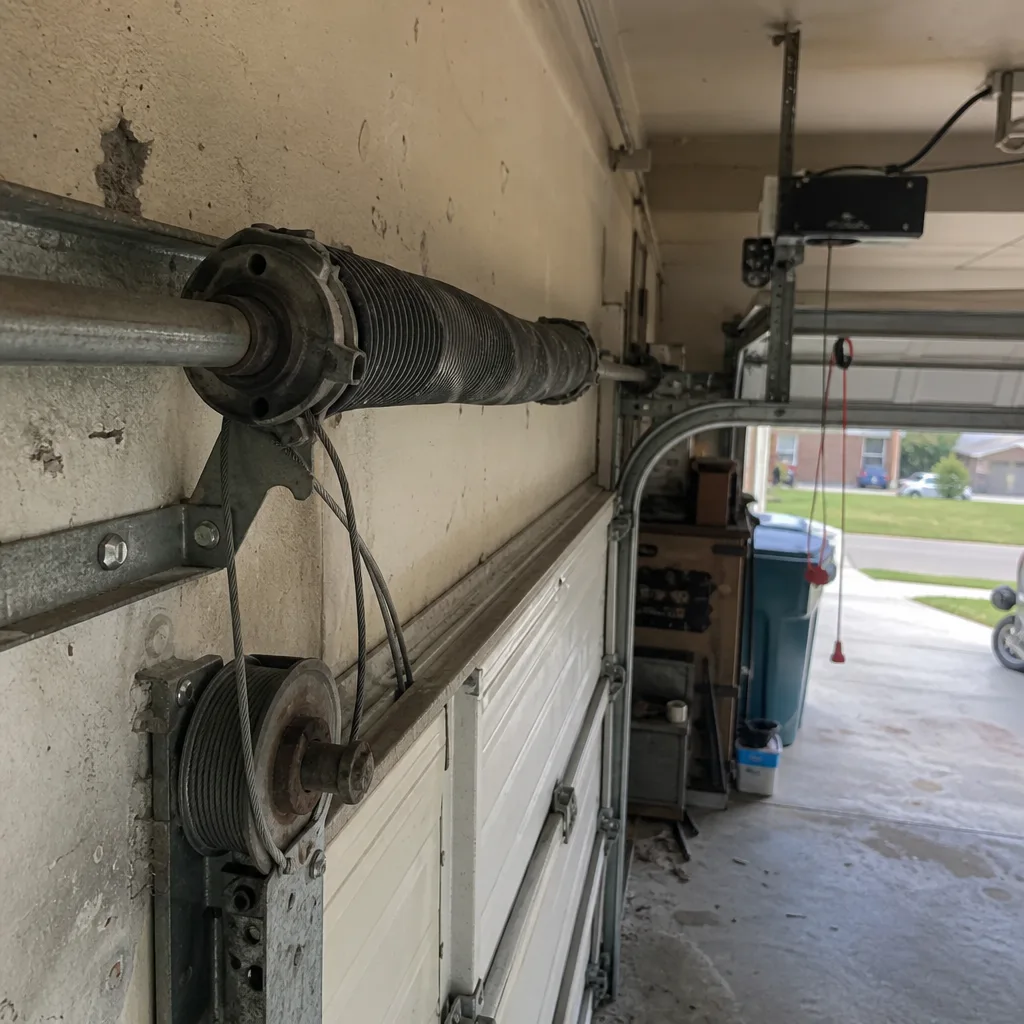 Before
 After
After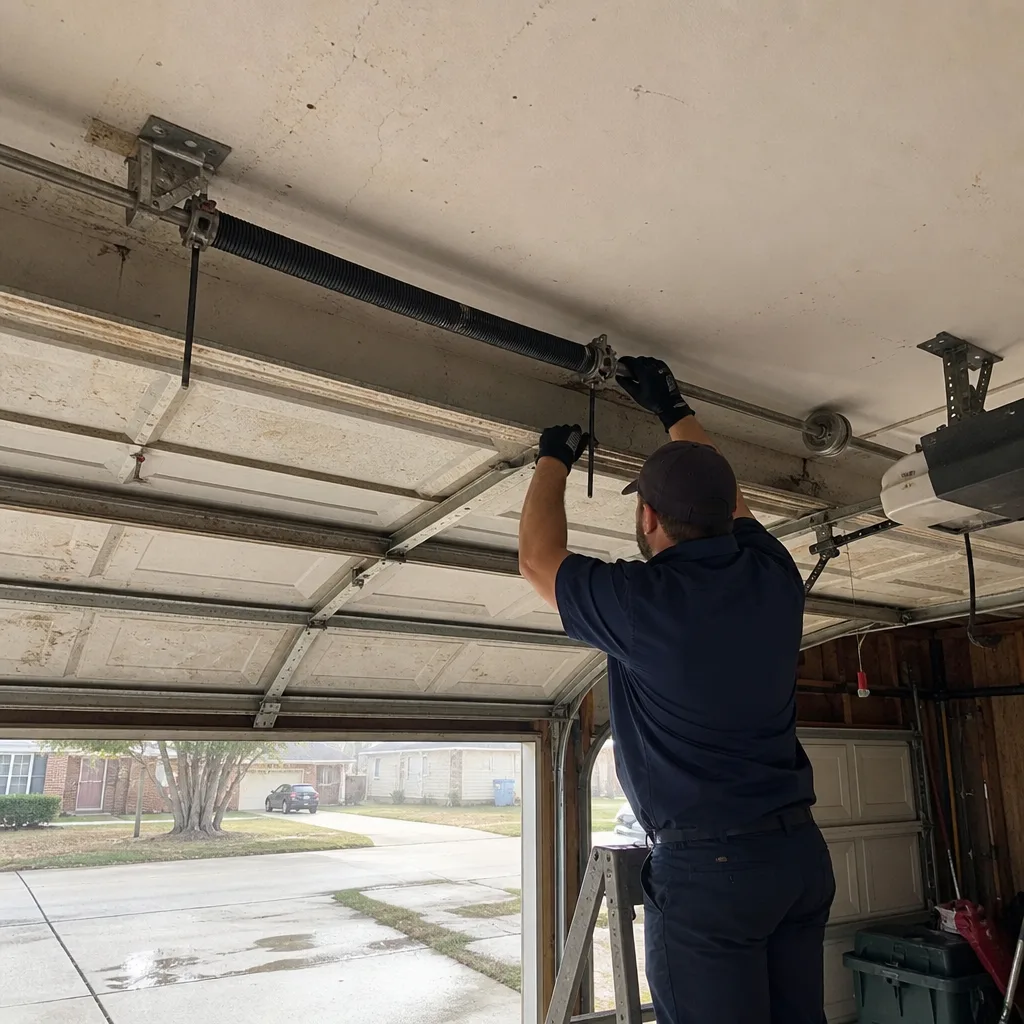 Before
 After
AfterDIY vs Professional Garage Door: The Rosenberg Homeowner’s Decision Guide
Torsion springs store roughly 100 foot-pounds of torque when wound - enough to fracture a wrist or worse if the winding bars slip. That is not a scare tactic; it is the mechanical reality that sets the boundary between tasks homeowners should do and tasks they should not. In Rosenberg, where summer humidity swells wooden door panels and clay soil shifts concrete slabs year-round, garage doors face conditions that complicate even straightforward repairs. This guide draws the line honestly, task by task, without talking anyone into unnecessary service calls. For more guides & resources, visit our blog. You will learn which jobs are genuinely within reach, which demand a trained technician, and how to calculate whether your time and safety are worth the savings.
Quick Answer
Most Rosenberg homeowners can safely handle lubrication, sensor alignment, and weatherstrip replacement themselves. Torsion spring replacement, cable repair, and track realignment should be left to professionals due to stored energy hazards and precise tension requirements. The deciding factor is not cost alone - it is risk-adjusted time, including the value of your hours, the cost of specialized tools, and the physical danger of the task. See our Garage Door Cost Breakdown: The Rosenberg Homeowner’s Reference for 2026 for detailed local pricing.
Table of Contents
- The Mechanical Reality: What Makes Garage Doors Dangerous
- DIY Task Assessment: What You Can Safely Handle
- Professional-Only Tasks: The Hard Boundary
- The Tools You Actually Need vs. What Their Absence Signals
- The Manual Balance Test: Your Pre-Call Diagnostic
- Time-Cost Analysis: Calculating Your True DIY Price
- How DIY Work Voids Manufacturer Warranties
- Rosenberg Climate and Soil Factors That Complicate Repairs
The Mechanical Reality: What Makes Garage Doors Dangerous
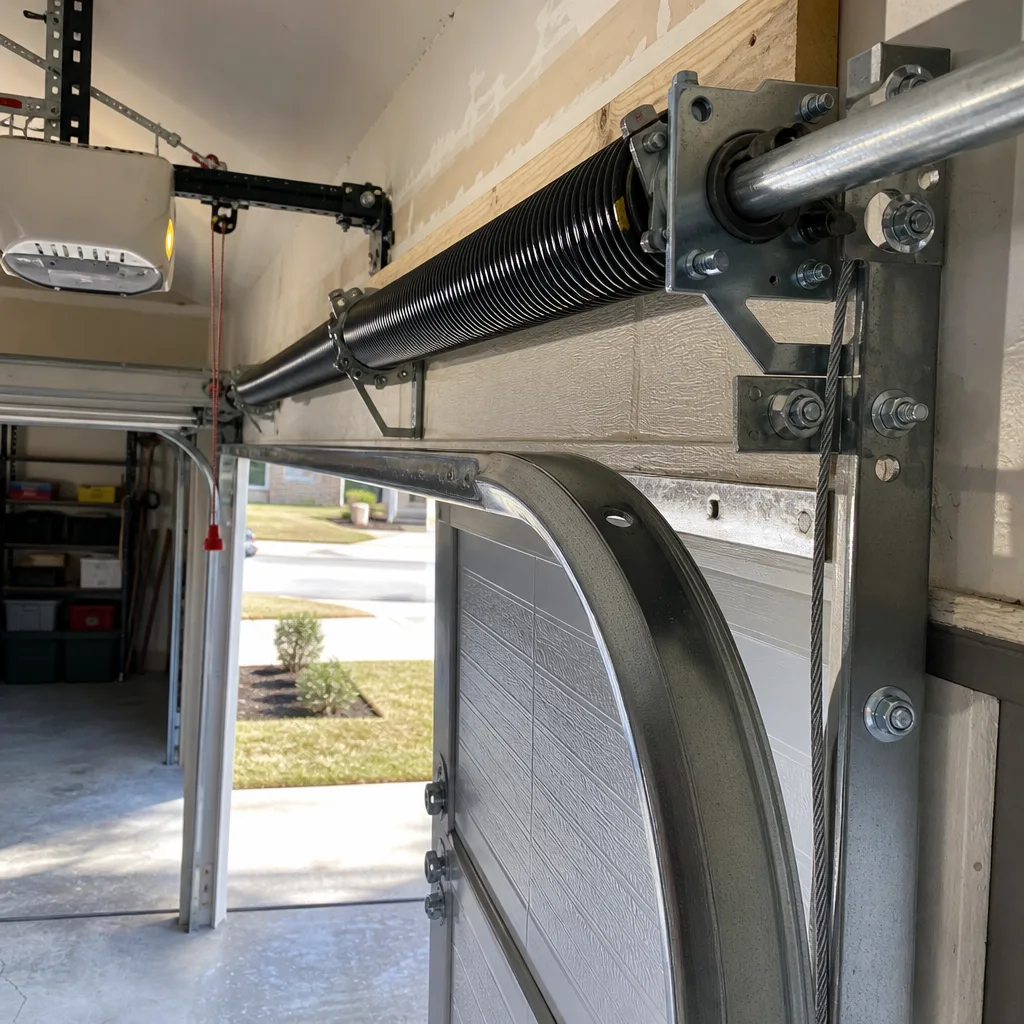
A standard residential garage door weighs between 150 and 400 pounds, depending on material and size. The torsion spring system - the coil above the door header - exists precisely because your opener cannot lift that weight directly. The spring stores mechanical energy equal to the door’s weight, counterbalancing it so a half-horsepower motor can raise and lower the panel with minimal strain.
Here is what that means in practical terms. When a torsion spring is fully wound, it contains enough stored energy to launch a steel winding bar across a garage with lethal force. We have seen bars embed in drywall. We have seen slipped bars break forearms. The hazard is not theoretical, and it does not diminish with confidence gained from a 12-minute video.
The danger extends beyond springs. Garage door cables run under extreme tension. Tracks are precision-aligned to within a quarter-inch. The opener’s force settings, if misadjusted, can crush an obstruction rather than reverse on contact. These systems are engineered to work within narrow tolerances, and they do not forgive approximation.
In Rosenberg, the hazard profile increases with age. Homes in established neighborhoods like Tamarron and Wood Creek often have original doors from the 1990s or earlier. Springs fatigue from cycle count, not just years. A door opened four times daily accumulates over 1,400 cycles annually. At ten years, that spring has performed 14,000 lifts. Fatigued metal behaves unpredictably. The spring that felt solid last month may fail catastrophically this month.
That said, not every component carries this risk profile. The electrical safety sensors, the weatherstripping, the roller lubrication - these operate at ambient pressure and present no stored-energy hazard. The task is to sort accurately, not to frighten universally.
DIY Task Assessment: What You Can Safely Handle
Certain garage door maintenance tasks are genuinely appropriate for a careful homeowner with basic tools. The common thread: no stored mechanical energy, no precision alignment, and no load-bearing components.
Lubrication of Rollers, Hinges, and Bearings
This is the highest-value DIY task and the most neglected. Proper lubrication reduces opener strain, extends spring life, and eliminates the grinding noise that prompts many unnecessary service calls.
- Disconnect the opener by pulling the red release cord.
- Manually lift the door halfway and verify it stays in position (this also performs the balance test described later).
- Apply silicone-based spray lubricant to each roller bearing, hinge pivot point, and the torsion spring itself. Do not use WD-40 as a lubricant; it is a solvent that strips protective oils.
- Wipe excess to prevent drip marks on vehicles or flooring.
- Reconnect the opener and test full travel.
In Rosenberg’s humidity, we recommend this every six months. The $89 Seasonal Tune-Up from Garage Door Repair in Rosenberg covers this plus spring tension verification and safety sensor testing, but the lubrication itself is well within homeowner capability.
Safety Sensor Realignment
Photo-eye sensors sit four to six inches above the floor on both tracks. When misaligned, the door reverses immediately or refuses to close. The fix is usually mechanical, not electrical.
- Clean both lenses with a soft cloth - pollen and dust accumulation is common in Rosenberg’s spring and fall.
- Verify both sensor LEDs are lit; one amber, one green is typical.
- Loosen the mounting bracket wing nut, adjust until both LEDs are steady, then retighten.
- Test with a cardboard box in the door path; the door should reverse on contact.
Weatherstrip Replacement
The bottom rubber seal and perimeter vinyl inserts degrade from UV exposure and temperature cycling. Replacement is unclipped and reclipped, or slid into a retainer channel. No tools beyond a utility knife and possibly a flathead screwdriver are required. Measure the width precisely; standard residential doors are 9 or 16 feet.
Remote and Keypad Battery Replacement
Obvious but worth stating: weak batteries cause intermittent response that mimics opener failure. Replace with lithium batteries for longer life in Rosenberg’s heat.
What These Tasks Share
None involve tension. None require measurement to a sixteenth of an inch. None, if performed incorrectly, can cause the door to fall or a component to release stored energy. That is the line.
Professional-Only Tasks: The Hard Boundary
Some tasks are not “difficult DIY” - they are non-DIY by definition, because the hazard is intrinsic to the physics and cannot be mitigated by care or instruction.
Torsion Spring Replacement
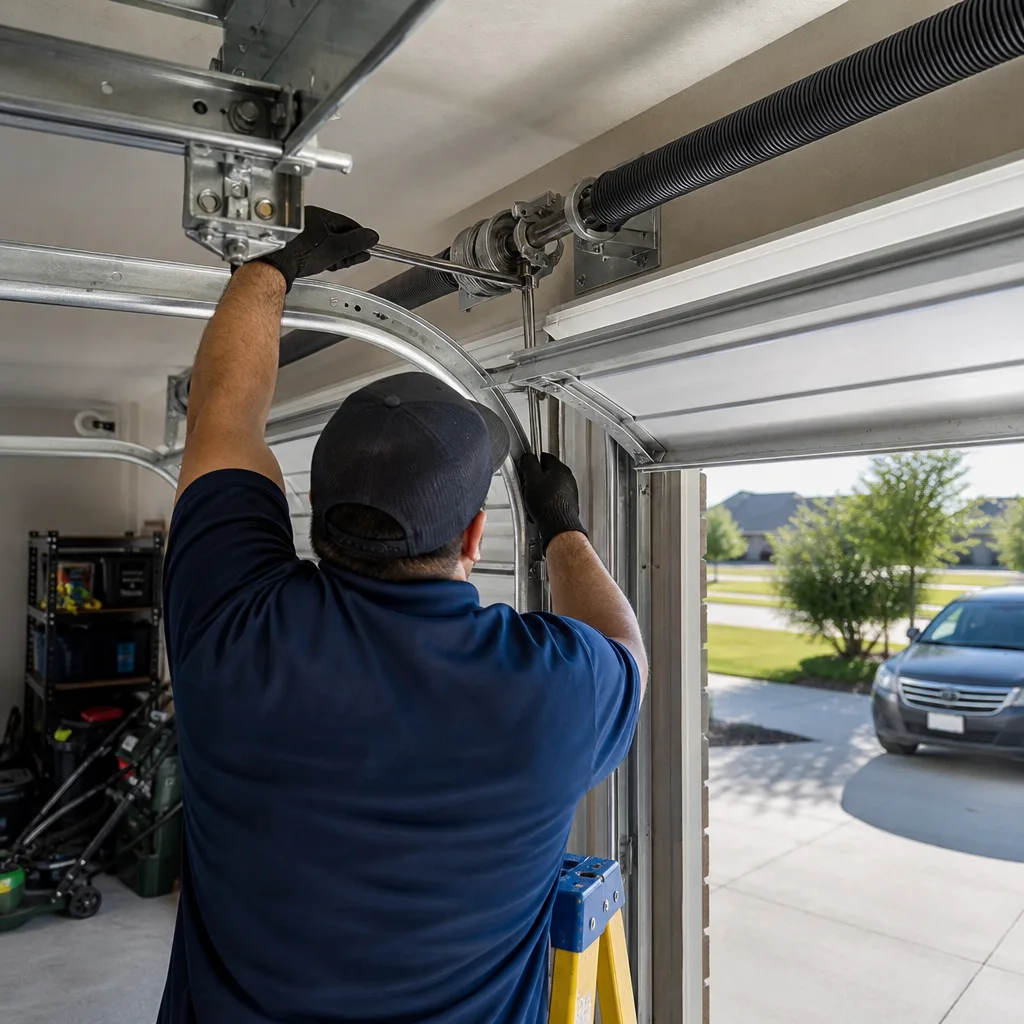
This is the clearest boundary. Winding a torsion spring requires two steel winding bars inserted into the cogs of a winding cone, with the technician adding or releasing tension in quarter-turn increments. The bars must be the correct diameter (typically half-inch or seven-sixteenths, depending on the cone). They must be solid steel, not adjustable wrenches or screwdrivers, which can slip or shatter.
The hazard is not the spring breaking - though that happens - it is the bar slipping from the cone under load. A single slip converts 100 foot-pounds of torque into instantaneous rotational force. We have responded to emergency calls in Rosenberg’s Pecan Grove and Seaborne Creek areas where homeowners attempted this after watching online tutorials. The results required emergency room visits and, in two cases we know of, surgical repair.
Spring replacement also demands accurate spring specification. The wire gauge, inner diameter, length, and wind direction must match precisely. A mismatched spring overworks the opener, creates uneven lift, and fails prematurely. We carry over 200 spring configurations on our trucks because the permutation space is that large.
Cable Repair and Replacement
Cables transfer spring torque to the bottom brackets that lift the door. When a cable frays or detaches, it does so under load. A released cable whips unpredictably. The proper repair requires releasing spring tension first - which returns us to the winding bar hazard - then precise re-drum winding to maintain level lift.
Track Realignment and Replacement
Vertical and horizontal tracks must be parallel within a quarter-inch and plumb within an eighth-inch. Misalignment causes binding, roller popping, and eventual panel damage. The adjustment involves loosening multiple lag bolts while the door is partially supported, a procedure that risks door drop if not properly braced.
Opener Force and Limit Adjustment
Modern openers have electronic force settings and travel limits. Misadjustment creates either a door that reverses on a leaf (nuisance) or one that fails to reverse on a child or pet (liability). The test procedures are specific and require a calibrated force gauge or known test weight. This is not a “turn the screw until it looks right” adjustment.
Panel Replacement and Section Repair
Individual panel replacement on a sectional door requires releasing cable tension to remove the bottom bracket, then precise re-engagement. The panels themselves are heavy and awkward, with pinch points at the hinge connections. We do not recommend this without two experienced technicians and proper door supports.
| Task | DIY Appropriate? | Core Hazard |
|---|---|---|
| Roller/hinge lubrication | Yes | None with power disconnected |
| Sensor cleaning/realignment | Yes | None |
| Weatherstrip replacement | Yes | None |
| Torsion spring replacement | No | Stored torque; bar slip injury |
| Cable repair | No | Stored tension; whip hazard |
| Track realignment | No | Door drop; pinch points |
| Opener force adjustment | No | Crush hazard if misadjusted |
| Panel/section replacement | No | Weight; tension release required |
The Tools You Actually Need vs. What Their Absence Signals
Legitimate DIY garage door work requires minimal investment. The absence of basic tools is a signal; the absence of specialized tools is a boundary.
Basic Tools That Indicate a Task Is Within Reach
- Silicone spray lubricant (not WD-40)
- Soft cloth and mild cleaner for sensor lenses
- Flathead screwdriver for weatherstrip retainers
- Tape measure for seal replacement
- Replacement batteries for remotes
If a task requires only these, it is almost certainly appropriate for DIY.
Specialized Tools That Signal “Stop and Call”
The moment you find yourself needing these, you have crossed into professional territory:
- Torsion winding bars: Solid steel, specific diameter, inserted into winding cones. No substitute exists. Adjustable wrenches, pipe wrenches, or screwdrivers will slip or fail.
- Winding cone tools: Manufacturer-specific devices for setting and releasing tension.
- Cable pullers and come-alongs: For controlled tension release and reapplication.
- Spring calipers and wire gauge: For measuring existing springs to specify replacements.
- Door supports or jack posts: For holding a partially disassembled door in position.
The cost of acquiring these tools for a single use exceeds most service call fees. More importantly, possession does not confer the judgment that comes from repeated application. We have trained our technicians through hundreds of supervised spring replacements before they work independently. The tool is necessary but not sufficient.
For Garage Door Installation in Rosenberg, the tool requirement expands further: level, plumb bob, shims, concrete anchors, and overhead door-specific jamb brackets. Installation is never a first-time DIY project.
The Manual Balance Test: Your Pre-Call Diagnostic
Before calling any service provider - including us - perform this test. It takes two minutes and determines whether a service call is necessary at all.
- Close the door fully.
- Disconnect the opener by pulling the red emergency release cord. The door is now manually operable.
- Lift the door to waist height and release it slowly.
- Observe the result:
- Door stays in position: Spring balance is correct. If the door was malfunctioning, the issue is likely opener-related (force settings, travel limits, or electrical).
- Door rises on its own: Springs are over-tensioned. This strains the opener and creates excessive upward force.
- Door falls to the floor: Springs are under-tensioned or fatigued. The opener is doing the spring’s work and will fail prematurely.
- Door drifts to one side: Uneven spring tension or cable issue. The door is torquing in the tracks.
- Reconnect the opener by pulling the release cord toward the motor unit while the door is in the closed position.
This test isolates the door mechanics from the opener electronics. A door that balances correctly but malfunctions with the opener attached points to opener service, not spring replacement. A door that fails the balance test needs spring or cable work regardless of opener condition.
In Rosenberg’s summer heat, we see false positives: thermal expansion can cause temporary binding that mimics balance failure. Run the test in morning cool if possible, or repeat after sunset. If the result is inconsistent, the door likely needs professional assessment.
For opener-specific issues, Garage Door Opener in Rosenberg covers diagnostic and replacement options.
Time-Cost Analysis: Calculating Your True DIY Price
The standard framing of DIY versus professional compares parts cost to service call cost. This is incomplete. The accurate comparison includes time, tool acquisition, error risk, and warranty value.
The Formula
True DIY Cost = (Parts) + (Your Hours × Your Hourly Value) + (Tool Purchase or Rental) + (Error Probability × Error Cost)
A Concrete Example: Spring Replacement
Parts: A pair of standard torsion springs, shipped, typically runs $80-$140 depending on wire size and length. Winding bars add $25-$40 if purchased correctly (solid steel, not hardware-store substitutes).
Time: A first-time spring replacement, including research, tool acquisition, and execution, consumes four to eight hours. The physical work itself is 45-90 minutes for an experienced technician. For a homeowner, plan on double that for the first attempt.
Hourly value: Use your actual income rate, or a conservative substitute. At $40/hour - modest for many Rosenberg homeowners - six hours equals $240 in foregone value.
Error cost: A slipped winding bar causing injury is incalculable. A less dramatic error - wrong spring specification, improper tension, dropped door - typically requires a professional rescue call at premium rates, plus replacement of damaged components. We have responded to such calls in Rosenberg’s Canyon Gate at Brazos and Stonefield subdivisions. The homeowner’s initial $120 parts purchase became a $400-$600 correction.
Professional flat rate: In the Rosenberg market, standard torsion spring replacement runs $180-$340 including parts, labor, and warranty. The $50 Off Any Repair Over $250 offer applies if your repair qualifies.
At six hours and $40/hour, your break-even is already at professional pricing before error risk. This is why we say the frame is risk-adjusted time, not raw cost.
When DIY Makes Economic Sense
Lubrication, sensor alignment, and weatherstrip replacement require under 30 minutes, zero tool purchase, and present near-zero error cost. These are clear DIY wins. The time-cost formula flips favorably because the hazard term approaches zero.
How DIY Work Voids Manufacturer Warranties
This is the point competitors rarely address with specificity. Manufacturer warranties on garage doors and openers contain explicit exclusions for improper installation or repair. The language matters.
Clopay’s residential warranty states that coverage is void if “damage results from improper installation, repair, or maintenance.” Amarr’s limited warranty excludes “damage caused by improper installation or application.” Wayne Dalton’s warranty similarly voids for “installation not in accordance with manufacturer’s instructions.”
The critical term is “improper,” not “unauthorized.” A homeowner who replaces a spring with the correct specification and proper technique has not inherently voided warranty. A homeowner who uses incorrect wire gauge, over-tensions, or damages panels during the process has voided warranty for the affected components.
The practical problem: warranty claims require documentation. A professional service provides an invoice specifying parts, specifications, and work performed. DIY provides no such trail. If a panel delaminates six months after a homeowner spring replacement, the manufacturer may deny coverage based on inability to verify that spring tension was correct - a primary cause of panel stress.
For new door installations, the warranty issue is sharper. Clopay, Amarr, and Wayne Dalton all require professional installation for full warranty coverage on complete door systems. The installation itself is a warranty term, not merely a repair contingency. A homeowner-installed door carries at best a materials-only warranty, and often no warranty at all.
This matters for Rosenberg buyers considering Mainspring Garage Door Co. home for installation. Our work is documented, specification-verified, and backed by both manufacturer warranty and our 90-Day Done Right Promise.
Rosenberg Climate and Soil Factors That Complicate Repairs
Generic DIY advice ignores local conditions that affect garage door performance and repair difficulty. Rosenberg presents specific challenges.
Humidity and Wood Doors
Summer humidity in Fort Bend County regularly exceeds 80%. Wooden doors, common in older Rosenberg homes near downtown and in Meadow Creek, absorb moisture and swell. A door that balanced correctly in March may bind in July. DIY lubrication helps, but panel plane adjustment requires releasing hardware under load - back to the hazard boundary.
Clay Soil and Foundation Movement
The expansive clay soils of the Brazos River valley shift with moisture. Garage door frames settle and twist subtly. Track alignment that was correct last year may be out of plumb this year. Professional realignment includes shimming the frame, not merely loosening track bolts - a distinction that matters for long-term function.
Wind Load Requirements
Rosenberg falls within Texas wind zone requirements. Doors must meet specific pressure ratings, and reinforcement struts are required on wider openings. A DIY panel replacement that ignores wind load specification creates a code violation and insurance exposure.
Pollen and Sensor Fouling
Pine and oak pollen in spring coats sensor lenses more heavily here than in arid regions. The cleaning procedure is simple, but the frequency is higher. We recommend monthly lens checks during March and April.
Power Reliability and Opener Battery Backup
Coastal storm patterns affect Rosenberg’s grid reliability. Modern opener installation should include battery backup, now required by Texas law for new installations. This is not a DIY electrical modification; it requires proper circuit assessment and opener specification.
Common Mistakes to Avoid
- Using the wrong lubricant. WD-40 strips protective oils and attracts dust. In Rosenberg’s dust-heavy environment, this creates abrasive paste that accelerates wear. Use silicone-based spray only.
- Ignoring the manual balance test. Homeowners who replace an opener without testing door balance burn out the new unit in months. The opener is not a substitute for failed springs.
- Adjusting force settings to compensate for mechanical problems. When a door reverses unexpectedly, increasing opener force masks an underlying balance or track issue. The “fix” creates a crush hazard.
- Using incorrect winding bar substitutes. We have seen socket extensions, screwdrivers, and pliers used in place of solid steel bars. Each has failed catastrophically. This mistake alone accounts for most DIY spring injuries.
- Neglecting to clamp the door during cable work. A door without cable support can drop freely. Even partial disassembly requires positive support, not assumption.
- Ordering springs by door weight alone. Spring specification requires wire gauge, inner diameter, length, and wind direction. Weight is insufficient and leads to dangerous mismatch.
- Assuming all brands use identical hardware. Craftsman, Raynor, and Wayne Dalton systems have proprietary components. Universal replacement parts often fit poorly and fail early.
When to Call a Professional
Call when the task involves stored mechanical energy, precision alignment, or load-bearing components. Call when the repair requires tools you do not own and will not use again. Call when warranty documentation matters. Call when your time is worth more than the savings, or when the error cost exceeds the professional fee.
Specific scenarios: the door falls during manual operation; cables are frayed or detached; springs show a visible gap in the coil; the door makes loud popping noises during travel; the opener motor runs but the door does not move; panels are cracked or delaminating; or the door has been damaged by vehicle impact.
Mainspring Garage Door Co. offers free estimates in Rosenberg. A technician will diagnose, quote a flat price before any work begins, and complete most repairs in a single visit with parts carried on the truck. Call (281) 315-3920 to schedule. Our Free Second Opinion applies to any written estimate you have received elsewhere.
Frequently Asked Questions
Standard torsion spring replacement in Rosenberg typically runs $180-$340, including parts, labor, and our 90-Day Done Right Promise. The exact price depends on spring specification - wire gauge, length, and whether one or both springs require replacement. We quote the flat price before any work begins. Call (281) 315-3920 for a free estimate.
On a two-spring system, we recommend replacing both simultaneously. Springs installed together have identical cycle fatigue. When one fails, the other is near failure. Replacing one creates uneven lift and typically requires a return call within months. The marginal parts cost of the second spring is minor compared to a second service call.
Standard springs are rated for 10,000 cycles. At four daily operations, that is roughly seven years. Rosenberg’s humidity accelerates surface corrosion on uncoated springs, potentially shortening life. We stock galvanized and coated springs for extended durability in coastal-influenced climates. High-cycle springs rated for 20,000 or 30,000 cycles are available for heavily used doors.
We honor manufacturer warranties on components we install. For doors installed by others, we assess whether the original installation was correct and documented. Our 90-Day Done Right Promise applies to all our work regardless of original installer. The Free Second Opinion offer lets you verify another company’s diagnosis and quote at no charge.
First, verify the opener is receiving power - check the outlet and breaker. If powered but unresponsive, pull the red emergency release cord to disconnect the opener, then lift the door manually. If the door is too heavy to lift, the spring has likely failed. Do not force it. The door is counterbalanced specifically to be manually liftable. Excessive weight indicates a hazardous condition requiring professional repair. Call (281) 315-3920 for emergency response; a live person answers every call, including nights and weekends.
We maintain a permanent 5% discount for seniors and veterans, applied to any repair or installation service. This is not a limited promotion; it is a standing policy. Mention eligibility when scheduling. The $50 Off Any Repair Over $250 and $89 Seasonal Tune-Up offers apply separately and may not be combined with other discounts on the same transaction.
The Bottom Line
The DIY versus professional decision for garage door work is not about capability or courage. It is about accurate hazard assessment and honest time valuation. Lubrication, sensor alignment, and weatherstrip replacement are sensible homeowner maintenance. Torsion spring work, cable repair, and track realignment belong to trained technicians with proper tools and the judgment that repetition builds.
In Rosenberg’s specific climate and soil conditions, doors age differently than in drier or more stable regions. The manual balance test is your most powerful diagnostic - perform it before any service call. When professional work is indicated, demand upfront pricing, written warranty, and documentation that preserves manufacturer coverage.
We have served this area since 1984. Our technicians arrive with the right parts, quote the flat price before the wrench turns, and stand behind the work for 90 days. That is a square deal, and it is how we have built the business for four decades.
Written by Carl Dutton, Owner at Mainspring Garage Door Co., serving Rosenberg since 2016.