
Last updated September 10, 2026
Full 25-point door and opener safety check with every visit - springs, cables, rollers, tracks, and your LiftMaster or Chamberlain opener included
You get a price before we start. It does not change when the truck arrives.
 Before
 After
After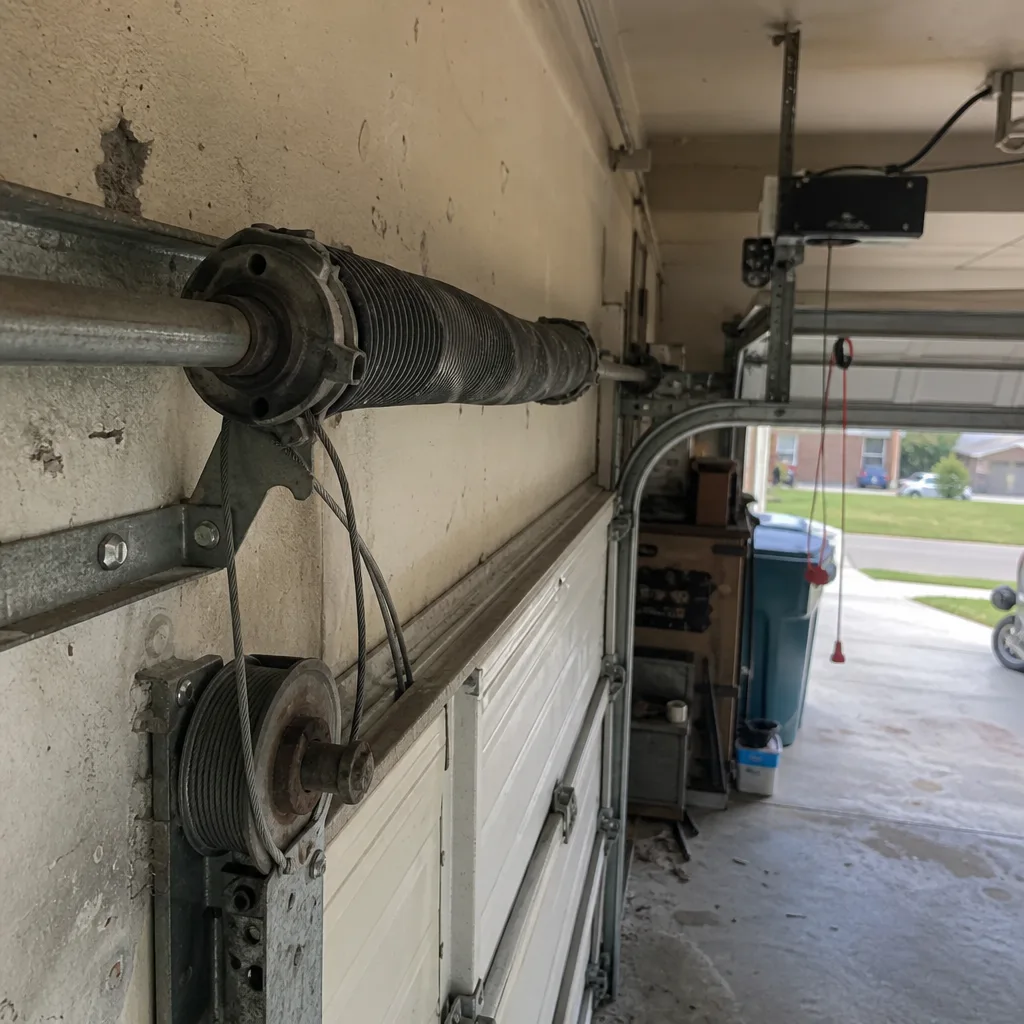 Before
 After
After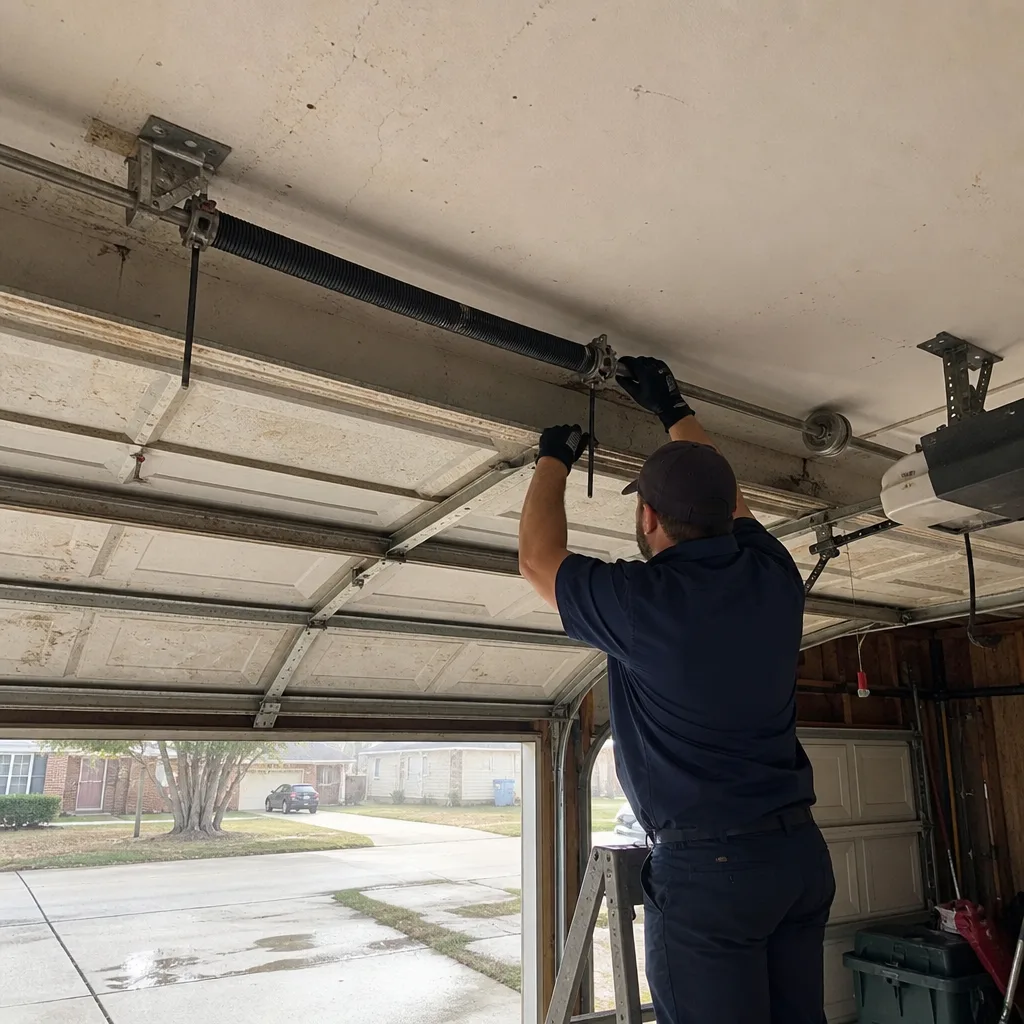 Before
 After
AfterGarage Door Cost Breakdown: The Rosenberg Homeowner’s Reference for 2026
A $299 garage door replacement ad in the Rosenberg market typically prices a door panel only. By the time springs, tracks, installation labor, and haul-away are added, the same job runs $800 to $1,400. The gap is not a bait-and-switch; it’s a reading problem. This reference strips every cost to its component parts so you can evaluate any quote against what the work actually involves. You’ll learn 2026 pricing for each piece of a garage door system, when repair beats replacement, and how to spot the hidden fees that turn a low bid into a mid-four-figure surprise. For more guides & resources, see our blog.
Quick Answer
In Rosenberg, a complete garage door replacement in 2026 costs $1,150 to $3,800 depending on door size, material, insulation, and whether the opener is included. A quality steel door with standard hardware and professional installation typically falls between $1,400 and $2,200. Repair costs range from $125 for a cable replacement to $340 for high-cycle spring work, with most service calls landing between $180 and $450.
Table of Contents
- Line-Item Costs: Every Component in a 2026 Rosenberg Replacement
- Spring Math: Why High-Cycle Springs Pay for Themselves
- Insulation Value in Texas: What R-Value Actually Saves You
- Repair vs. Replace: The Depreciation Crossover Point
- How to Compare Quotes: The Component Checklist Method
- Hidden Fees and Exclusions to Watch For
- Brands and Hardware: What You’re Actually Buying
- Common Mistakes to Avoid
- When to Call a Professional
- Frequently Asked Questions
- The Bottom Line
Line-Item Costs: Every Component in a 2026 Rosenberg Replacement
Most quotes in the Rosenberg market bundle everything into one number. That makes comparison shopping nearly impossible. Here is how the costs break out when you pull them apart.
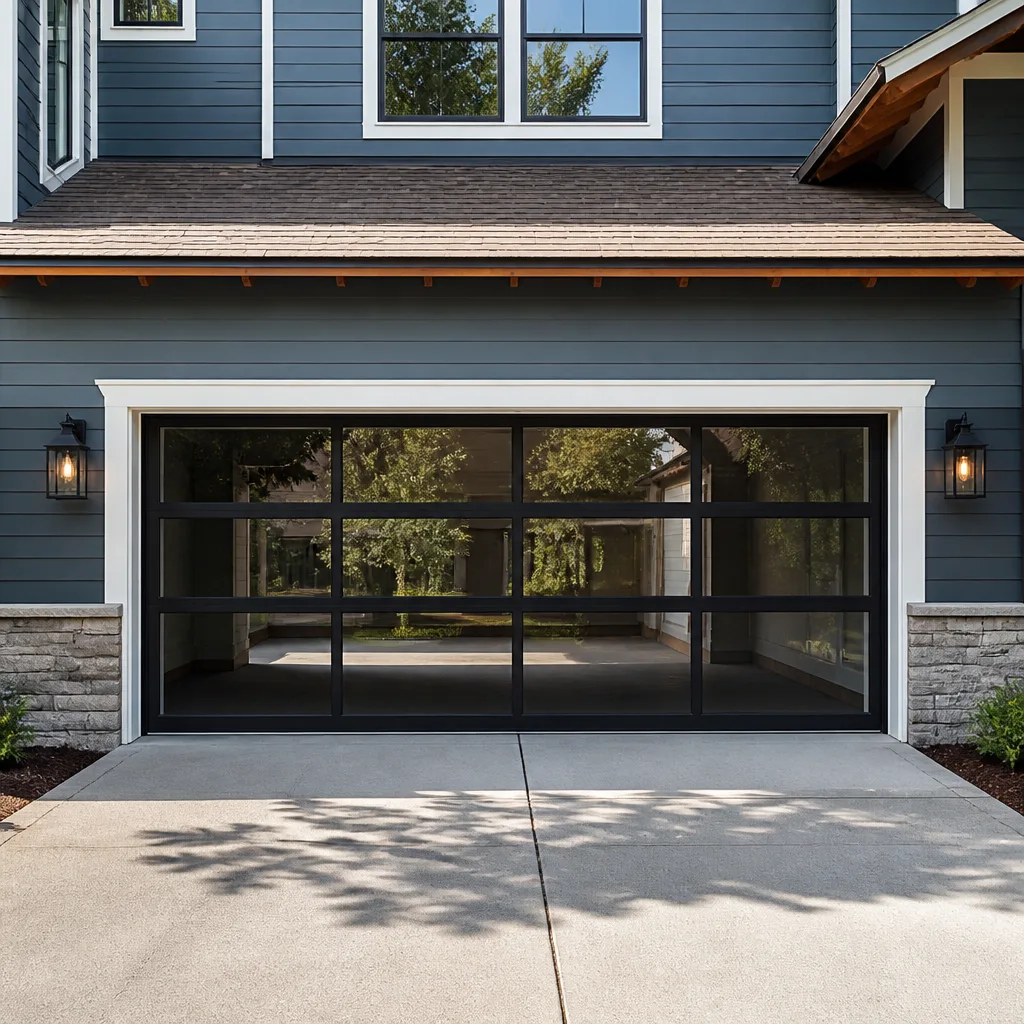
The door itself. A basic non-insulated steel door runs $400 to $700 for a single-car opening and $650 to $1,100 for double-car. Step up to insulated steel with an R-value of 10 to 16, and you’re looking at $700 to $1,400 single, $1,100 to $2,200 double. Wood composite doors start around $1,200 and climb past $3,500 for custom designs. Full-view aluminum and glass, popular in newer Rosenberg developments like Canyon Gate at the Brazos, range from $2,500 to $4,500 depending on panel count and glass type.
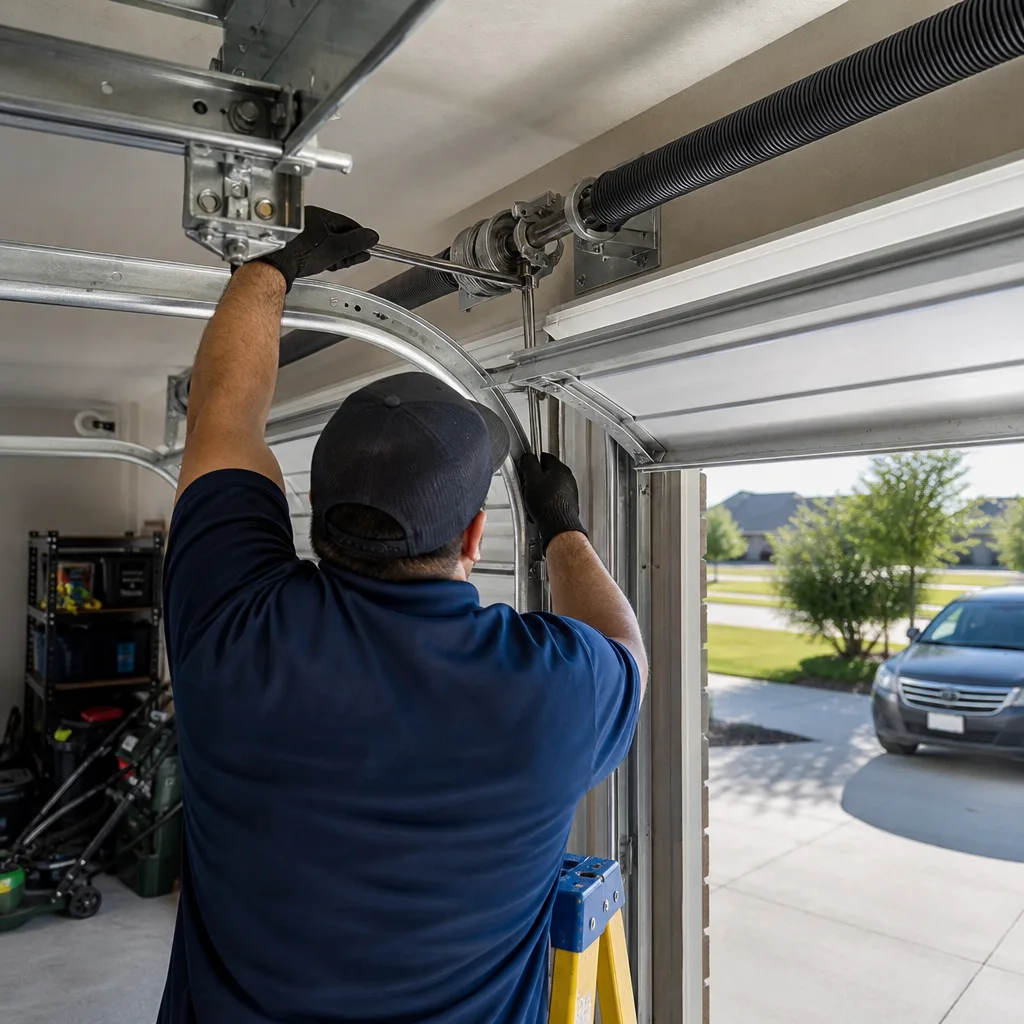
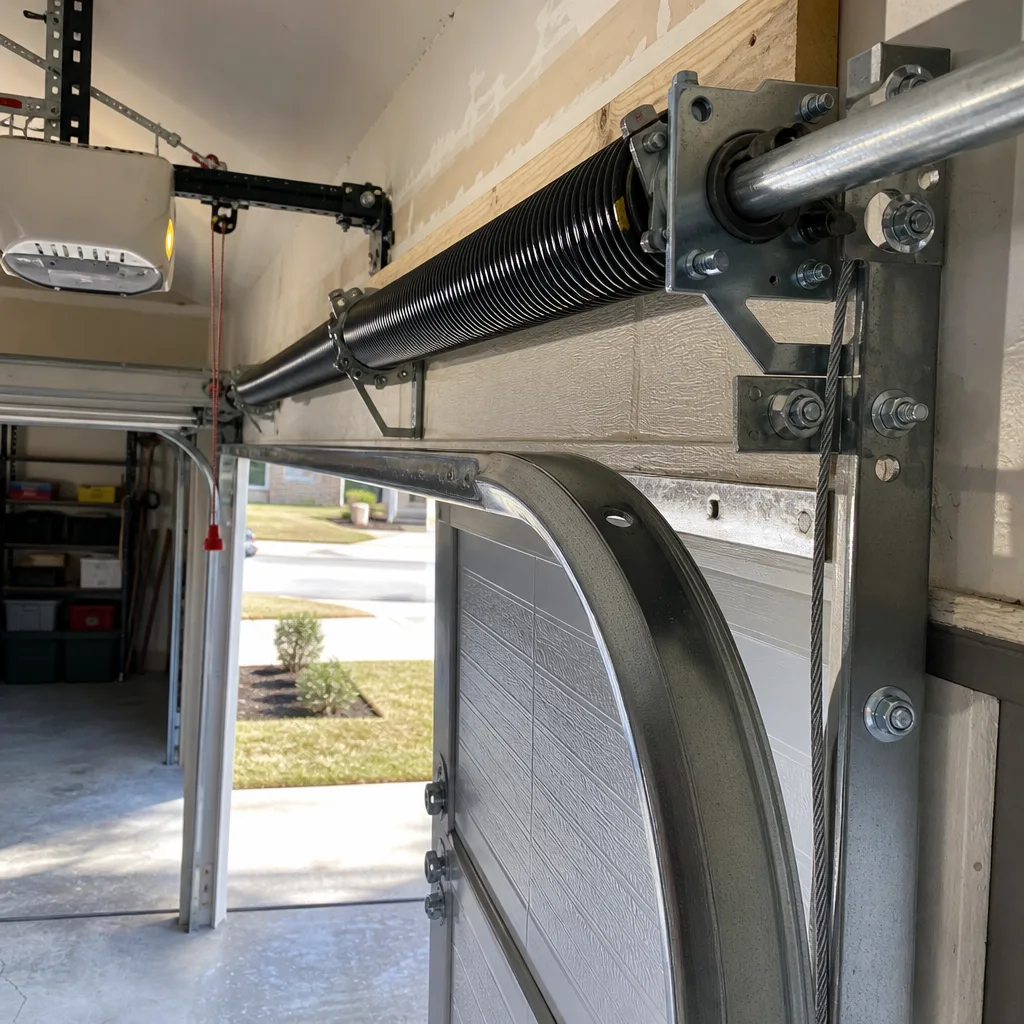
Spring system. Standard torsion springs for a typical 16×7 door cost $80 to $140 per spring in material. High-cycle springs rated for 25,000 to 50,000 cycles run $140 to $260 each. Most residential doors need two springs. The labor to install them properly, including winding and balance testing, adds $150 to $280.
Cables, rollers, and hardware. Cables run $25 to $45 per pair. Standard steel rollers are $30 to $60 for a full set of ten to twelve. Nylon rollers with sealed bearings, which we recommend for Rosenberg’s dust and humidity, cost $60 to $120. Hinges, brackets, and fasteners add another $40 to $80. These items look small on the invoice but they determine whether your door runs quiet or chatters through every cycle.
Track system. Standard 2-inch steel tracks cost $120 to $200 for a complete set. Heavy-duty or low-headroom tracks run $200 to $350. If your garage has a finished ceiling or tight clearance, the track configuration becomes a significant line item.
Opener. Chain-drive openers with basic remotes start at $180 to $280. Belt-drive models, which we prefer for attached garages in Rosenberg neighborhoods like Pecan Grove where bedrooms sit near the garage wall, run $280 to $450. Jackshaft or wall-mount openers for high-lift or limited-headroom applications cost $400 to $650. Smart-home connectivity adds $50 to $100.
Labor. Professional installation in the Rosenberg market runs $350 to $650 for a standard replacement. Complex jobs, oversized doors, or conversions from extension to torsion spring systems push toward $800 to $1,200. This line item is where low bids often cut corners, sending an installer alone rather than a two-person team or rushing the balance and safety checks.
Disposal and haul-away. Removing and disposing of the old door, springs, and hardware costs $75 to $150. Some contractors bury this in overhead; others itemize it. Either way, you’re paying it.
Permits and inspection. Rosenberg requires a building permit for new garage door installations in most cases. Permit fees run $50 to $125. Reputable contractors pull the permit and schedule inspection as part of the job. If your quote lacks this line, ask who handles it. See Garage Door Permits, Codes & Inspections in TX: What You Need to Know for details.
| Component | Single-Car Range | Double-Car Range |
|---|---|---|
| Door (steel, insulated) | $700 - $1,400 | $1,100 - $2,200 |
| Spring system (installed) | $230 - $420 | $280 - $540 |
| Cables, rollers, hardware | $95 - $245 | $120 - $300 |
| Track system | $120 - $200 | $150 - $350 |
| Opener (installed) | $280 - $550 | $320 - $650 |
| Labor | $350 - $650 | $450 - $800 |
| Disposal | $75 - $150 | $100 - $200 |
| Permit | $50 - $125 | $50 - $125 |
| Typical Total | $1,150 - $2,740 | $1,500 - $3,800 |
Spring Math: Why High-Cycle Springs Pay for Themselves
Standard torsion springs are rated for 10,000 cycles. A cycle is one open-and-close. If you use your garage door four times daily, that’s 1,460 cycles yearly. Your standard springs last six to seven years. High-cycle springs rated at 25,000 cycles last fifteen to seventeen years at the same usage. At 50,000 cycles, you’re looking at thirty-plus years.
The upfront cost difference is $120 to $240 in material and labor. Over ten years, standard springs need replacement once. High-cycle springs do not. In Rosenberg’s climate, where humidity fluctuations accelerate metal fatigue, the gap widens. We’ve replaced standard springs in Brazos Town Center homes at five years while high-cycle springs in comparable conditions run past twelve.
Here is the ten-year math for a typical Rosenberg household:
- Standard springs: $280 installed initially, plus $340 replacement at year six including inflation and a service call fee. Total ten-year cost: $620.
- 25,000-cycle springs: $400 installed initially, no replacement within ten years. Total ten-year cost: $400.
- Net savings with high-cycle: $220 over ten years, plus two avoided service disruptions and the safety risk of a failed spring.
The break-even point comes at roughly year four. After that, every cycle is money in your pocket. We install high-cycle springs as our default on replacement jobs unless a homeowner specifically requests otherwise. The price difference is stated upfront, and the choice is yours. Either way, there are no surprises on the bill.
Insulation Value in Texas: What R-Value Actually Saves You
Most online insulation guides assume a Midwestern climate with subzero winters. Rosenberg is different. Our heating degree days are minimal. Our cooling degree days are substantial. A garage door’s insulation value matters, but the payback calculation shifts.
An uninsulated steel door in a west-facing garage in Rosenberg absorbs afternoon sun and radiates heat into the garage for hours after sunset. If your garage shares a wall with conditioned space, or if you use the garage as workshop, gym, or laundry area, that heat load matters. An R-10 to R-16 door reduces conductive heat transfer by roughly 60 to 75 percent compared to uninsulated steel.
The upgrade cost from uninsulated to insulated steel is typically $300 to $600 for a double-car door. In our experience with Rosenberg homeowners, particularly in neighborhoods like Tavener and Greatwood where garages often serve as secondary living space, the comfort improvement is immediate and measurable. HVAC systems in adjacent rooms work less hard. Garage temperatures stay ten to twenty degrees closer to indoor conditions.
Energy payback depends on your specific situation:
- Detached garage, no HVAC: Insulation saves little on utilities. Buy for noise reduction and door rigidity if those matter to you.
- Attached garage, garage door faces west or south: Payback period of four to seven years at current Texas electricity rates, faster if rates climb.
- Garage used as workshop, exercise space, or with pets: Comfort value exceeds pure energy savings. The upgrade is worth it regardless of payback math.
- Plan to sell within three years: Insulated door adds curb appeal and buyer confidence. Recovery at sale often exceeds the upgrade cost.
The R-value printed on the door measures the center-of-panel value. The whole-door performance, including edges and hardware penetrations, runs lower. A well-installed R-10 door outperforms a poorly sealed R-16. Installation quality matters as much as the number on the sticker.
Repair vs. Replace: The Depreciation Crossover Point
Not every failing door needs replacement. The decision turns on age, condition, and what we call the cumulative repair threshold. Here is how we advise Rosenberg homeowners.
A quality steel door installed in the last fifteen years with intact panels and functional hardware is almost always worth repairing. Replace the springs, refresh the rollers and cables, and you have another decade of service. The typical repair bill of $280 to $520 compares favorably to $1,500-plus for replacement.
Cross into the fifteen-to-twenty-year range, and the math shifts. Panels fatigue at the hinge points. Tracks wear at the curves. The door may be structurally sound but approaching the end of every component’s lifespan. At this stage, we look at the cumulative repair threshold: if the needed repairs exceed 40 percent of replacement cost, replacement is the better economic decision.
Beyond twenty years, replacement is usually the recommendation. Parts availability narrows. Panel styles change, making matching impossible if a section is damaged. The door predates current safety standards. In Rosenberg’s older neighborhoods like Downtown Rosenberg or near the historic district, we see original doors from the 1980s and 1990s still in service. They can be kept running, but the cost to do so rises each year.
Specific scenarios where repair is the clear choice:
- Broken spring on a door under twelve years old with good panels and hardware. Repair cost: $180 to $340. Replacement would be wasteful.
- Off-track door with intact cables and undamaged rollers. Often a $125 to $200 adjustment.
- Opener failure with a door under ten years old. Replace the opener, not the door.
Specific scenarios where replacement is the clear choice:
- Multiple failed panels on a door over fifteen years old. Panel replacement is often unavailable; even if available, the cost approaches half of a new door.
- Rust damage to the bottom section, common in Rosenberg homes with poor drainage or sprinkler contact. Rust spreads; repair is temporary.
- Extension spring system on a door over twenty years old. Conversion to torsion is possible but rarely economical versus full replacement with modern hardware.
Carl Dutton and our team at Garage Door Repair in Rosenberg provide free second opinions on any written estimate. If you’re uncertain which side of the crossover your door sits on, we’ll tell you straight.
How to Compare Quotes: The Component Checklist Method
The lowest bottom-line number is rarely the best deal. Use this checklist to force every quote into the same format, and watch for these Garage Door Warning Signs: A Rosenberg Homeowner’s Reference Guide before committing.
Step 1: Verify the door specification. Manufacturer, model number, panel style, gauge thickness, and R-value. A “steel door” quote without these details could be 24-gauge economy or 25-gauge residential. The difference in dent resistance and noise is substantial.
Step 2: Confirm spring rating. Standard or high-cycle? What cycle count? How many springs? A single spring on a double-wide door is a red flag. Two springs last longer and provide redundancy if one fails.
Step 3: List all hardware. Cables, rollers, hinges, brackets, track. Are rollers steel or nylon? Are bearings sealed? Is track standard or heavy-duty?
Step 4: Note the opener. Brand, model, drive type, horsepower, and included accessories. A quote with “opener included” and no model number is an invitation to a bottom-tier unit.
Step 5: Check labor scope. How many technicians? How many hours estimated? Is removal and disposal included? Is permit pulling included? Is final inspection walkthrough included?
Step 6: Ask about warranty. Door panel warranty, spring warranty, labor warranty, and opener warranty are four separate items. A one-year “warranty” on springs that fail at fourteen months helps no one. Our Mainspring Garage Door Co. home page details our 90-Day Done Right Promise, which covers all work with no paperwork or dispute if anything is not right.
Step 7: Request the total with no exclusions. The number you need is the check you will write when the job is complete. Anything less is not a real quote.
In our 42 years serving this area, we’ve seen Rosenberg homeowners save money by spending more upfront. A $1,600 quote with quality components and solid labor beats a $1,100 quote that omits the opener, uses standard springs, and charges extra for haul-away.
Hidden Fees and Exclusions to Watch For
The Rosenberg market has honest operators and others who rely on the fine print. These are the charges that appear after you’ve committed.
Trip or service fees added after the quote. Some companies quote a repair price, then add a $75 to $125 “trip charge” on the invoice. Ask whether the quoted price includes travel to your Rosenberg address.
Disposal fees as add-ons. The old door, springs, and packaging must go somewhere. If disposal is not in the quote, it will appear later, or worse, the debris will be left on your driveway.
Opener “allowance” rather than specific model. A $200 opener allowance sounds generous until you learn the installed price of the model you want is $400. The allowance covers a unit you would not choose.
Permit costs passed through with markup. The Rosenberg permit fee is $50 to $125. Some contractors add “permit handling” fees of $150 to $250. Ask whether permit costs are at actual city rates.
Weekend or emergency premiums on scheduled work. True emergency service at night or on Sunday carries a premium. But a Tuesday installation that happens to be your day off should not.
Hardware upgrades mid-job. “Your track is worse than we thought” is a common pressure tactic. A thorough pre-job inspection should catch track condition. If a contractor has not examined your existing hardware, the quote is not firm.
At Mainspring, the price we state before any work begins is the price on the invoice. If we find something unexpected, we discuss it before proceeding. No surprises on the bill is not a slogan here. It is how we have operated since 1984.
Brands and Hardware: What You’re Actually Buying
Brand names on garage doors and openers indicate manufacturing source, not necessarily quality tier. A Clopay Coachman collection door is a different product than Clopay’s entry-level Classic line. Understanding the hierarchy helps you evaluate quotes fairly.
Doors. Clopay manufactures in multiple quality tiers from builder-grade to premium. Their Gallery Steel and Canyon Ridge lines are common in Rosenberg’s mid-market homes. Amarr offers similar stratification. Wayne Dalton focuses on value-engineered products with decent longevity. For custom or architectural applications, Raynor and some Clopay collections dominate.
We are factory-familiar with all major brands and do not push one over another without reason. The right door depends on your home’s architecture, your budget, and how long you plan to stay. In Rosenberg’s newer construction, a standard insulated steel door from any major brand, properly installed, provides fifteen to twenty-five years of service.
Openers. LiftMaster and Chamberlain share a parent company and much of their engineering. LiftMaster tends toward professional-grade features and longer warranties. Chamberlain targets retail with more consumer-facing smart home integration. Genie offers competitive belt-drive options at slightly lower price points. For heavy or oversized doors, we prefer LiftMaster’s 3/4-horsepower and jackshaft models for reliability under load.
The opener brand matters less than proper installation and adjustment. A premium opener poorly balanced will fail before a mid-tier unit installed correctly. Our technicians are trained on all major brands and carry common models on the truck for same-day completion of most Garage Door Opener in Rosenberg jobs.
When comparing quotes, ask for model numbers, not brand names alone. Then look up specifications independently. A “LiftMaster opener” could be a $180 bare-bones unit or a $550 belt-drive with battery backup and smartphone control.
Common Mistakes to Avoid
- Comparing only the bottom line. A $1,200 quote and a $1,800 quote for the “same door” are rarely the same job. Break both into components before deciding.
- Ignoring spring cycle rating. Standard springs save $120 now and cost $340 in five to seven years. The long view favors high-cycle.
- Buying for R-value alone in a detached garage. If your garage is unconditioned and unconnected to your home, premium insulation returns little. Buy for durability and appearance instead.
- Accepting a verbal quote for replacement work. Installation involves too many variables for a phone estimate to be binding. Insist on written, itemized pricing after measurement.
- Assuming all permits are equal. Rosenberg requires inspection for structural and safety compliance. A contractor who “doesn’t bother with permits” leaves you with uninspected work and potential liability at sale.
- Neglecting the opener in replacement quotes. A new door with a fifteen-year-old opener is a mismatch. The opener works harder, wears faster, and may lack safety features that match the new door’s capabilities.
- Choosing the lowest repair bid for broken springs. Spring replacement involves stored energy that can cause serious injury. The lowest bid often skips safety cables, proper winding bars, or balance testing. This is not a place to cut corners.
When to Call a Professional
Some garage door work belongs to trained technicians. High-tension spring replacement, cable repair, and track realignment involve significant injury risk from released energy or falling components. If your door is stuck open, hanging crooked, or making loud popping sounds, stop using it and call for service.
Also call a professional when you’re considering replacement and need accurate measurement, when your opener lacks modern safety sensors, or when you’re unsure whether a problem is mechanical or electrical. A misdiagnosed issue leads to unnecessary parts and labor.
Mainspring Garage Door Co. offers free estimates in Rosenberg. Carl Dutton and our team arrive with the parts to complete most jobs in a single visit, and we state the flat price before any work begins. Call (281) 315-3920 to schedule a time that works for you.
Frequently Asked Questions
A complete replacement including door, hardware, springs, tracks, opener, labor, and haul-away runs $1,150 to $3,800 depending on door size, material, and features. Most standard insulated steel double-car replacements fall between $1,500 and $2,400. Call (281) 315-3920 for a free written estimate with exact pricing for your door and options.
Panel replacement is possible if the manufacturer still produces your door style and color, typically for doors under ten years old. Cost ranges from $250 to $600 per panel plus labor. For doors over fifteen years old, matching is usually impossible and replacement is more economical. We can assess whether your door qualifies during a free estimate visit.
The variation reflects spring quality, cycle rating, and whether the quote includes full hardware inspection and balance adjustment. A $140 spring job using economy springs with no warranty differs fundamentally from a $340 job with high-cycle springs, safety cables, and a two-year warranty. Ask what is included before comparing numbers.
Yes, particularly for front-facing garage doors that dominate curb appeal. In Rosenberg’s competitive resale market, a new door returns 85 to 95 percent of cost according to regional remodeling data, among the highest returns of any exterior upgrade. The effect is strongest in neighborhoods with consistent architectural standards like Pecan Grove or Canyon Gate.
Standard replacement of a residential door with existing opener compatibility takes four to six hours. Full system replacement including opener, tracks, and hardware takes six to eight hours. We schedule the work, measure and order precisely, and arrive with everything needed to finish in one day. No waiting on parts, no return trips.
No. Our written quote after measurement is the price you pay. The only exception is if you request changes or additions after quote approval. We do not discover “unexpected problems” that inflate the bill. That is our promise, and it is why Rosenberg homeowners have called us back for forty-two years. Call (281) 315-3920 to schedule your free estimate.
The Bottom Line
Garage door pricing in Rosenberg does not have to be a mystery. The $299 advertised special is a door panel, not a working system. Real replacement costs $1,150 to $3,800 when every component is accounted for honestly. High-cycle springs repay their premium within four years. Insulation pays back fastest for west-facing attached garages and multi-use spaces. Repair beats replacement until cumulative costs exceed 40 percent of new, typically around the fifteen-year mark. And the lowest quote is rarely the best value when you compare component by component.
We have served Rosenberg and surrounding communities since 1984 because we believe homeowners deserve a square deal, stated upfront, with no surprises on the bill. If you’re weighing repair against replacement or comparing quotes that do not line up, we will walk through the numbers with you. No pressure. No phone trees. Just a live person and an honest assessment.
Call (281) 315-3920 for your free estimate. Mention this guide for our $50 off any repair over $250, or ask about our $89 seasonal tune-up to extend your current door’s life. Seniors and veterans receive a permanent 5 percent discount on every job.
Written by Carl Dutton, Owner at Mainspring Garage Door Co., serving Rosenberg since 2016.